
The Los Angeles Chargers and New York Giants delivered an entertaining NFL matchup on September 28, 2025. The Giants defended their home field at MetLife Stadium in East Rutherford, New Jersey, and secured a 21–18 victory over the Chargers.
The game featured an impressive rushing performance from Chargers rookie Omarion Hampton, an encouraging debut start from Giants quarterback Jaxson Dart, and several crucial defensive plays. Although Los Angeles finished with more total offensive yards, New York made better use of its opportunities and protected its lead in the fourth quarter.
For fans searching for los angeles chargers vs new york giants match player stats, this breakdown covers the final score, quarterback numbers, rushing and receiving performances, team statistics, touchdowns, turnovers, and the key moments that decided the game.
The final score was close, but the statistical story was more complicated. Los Angeles moved the ball effectively at times, yet penalties and interceptions hurt its chances. New York, meanwhile, relied on efficient quarterback play, a productive running game, and better possession management to earn the win.
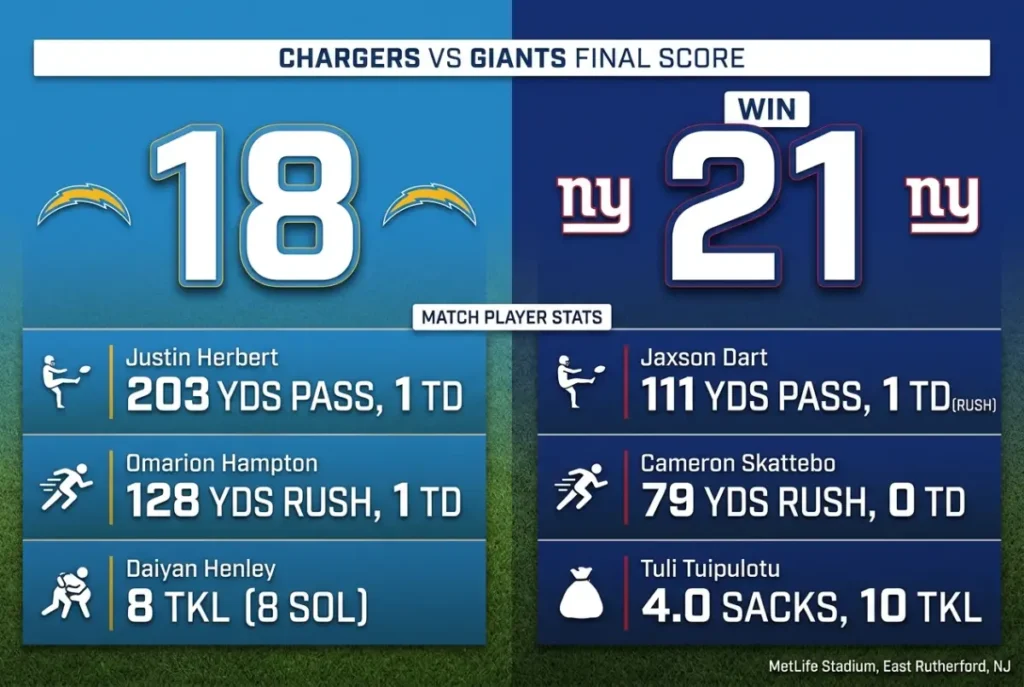
1. Chargers vs Giants Final Score and Game Summary
| Game detail | Result |
|---|---|
| Away team | Los Angeles Chargers |
| Home team | New York Giants |
| Final score | Chargers 18 – Giants 21 |
| Winner | New York Giants |
| Venue | MetLife Stadium |
| Chargers total net yards | 338 |
| Giants total net yards | 250 |
| Chargers time of possession | 24:32 |
| Giants time of possession | 35:28 |
The Giants won by three points despite finishing with 88 fewer net yards than the Chargers. That difference shows why total yardage alone does not determine the outcome of an NFL game.
New York controlled possession for almost 11 minutes longer than Los Angeles. The Giants also benefited from two interceptions thrown by Chargers quarterback Justin Herbert, which made it harder for the visitors to turn their offensive production into a comeback.
The Chargers had several strong individual performances, especially on the ground. Hampton broke free for a 54-yard touchdown run, while wide receiver Quentin Johnston recorded the team’s leading receiving total.
For New York, Dart contributed through both the air and on the ground. His ability to avoid interceptions and score a rushing touchdown helped the Giants maintain control during important stretches.
2. Justin Herbert Passing Stats
Justin Herbert led the Chargers’ passing attack and completed 23 of 41 attempts for 203 yards, one touchdown, and two interceptions.
| Passing statistic | Justin Herbert |
|---|---|
| Completions | 23 |
| Pass attempts | 41 |
| Completion percentage | 56.1% |
| Passing yards | 203 |
| Passing touchdowns | 1 |
| Interceptions | 2 |
| Sacks taken | 2 |
| Yards lost on sacks | 17 |
| Longest completion | 36 yards |
| Passer rating | 57.3 |
Herbert’s most important passing play came when he connected with Johnston on a 36-yard touchdown. The completion gave Los Angeles a valuable scoring boost and demonstrated its ability to create explosive plays.
However, the two interceptions proved costly. Turnovers can change field position immediately, and both mistakes made the Chargers’ path to victory more difficult.
Herbert attempted 41 passes, reflecting the team’s reliance on its passing attack. Yet his completion rate and turnovers prevented the passing numbers from translating into a winning result.
This performance also illustrates why evaluating a quarterback requires more than counting passing yards. Touchdowns, interceptions, completion percentage, sacks, and situational decision-making all matter.
Despite the defeat, Herbert still moved the offense downfield and gave the Chargers opportunities to score. The challenge was finishing drives without allowing costly mistakes to shift momentum toward New York.
3. Jaxson Dart Passing Stats
Jaxson Dart made his first NFL start for the Giants in this game. The rookie quarterback delivered an efficient performance, completing 13 of 20 passes for 111 yards, one touchdown, and no interceptions.
| Passing statistic | Jaxson Dart |
|---|---|
| Completions | 13 |
| Pass attempts | 20 |
| Completion percentage | 65.0% |
| Passing yards | 111 |
| Passing touchdowns | 1 |
| Interceptions | 0 |
| Sacks taken | 5 |
| Yards lost on sacks | 25 |
| Longest completion | 18 yards |
| Passer rating | 96.0 |
Dart’s passing yardage was lower than Herbert’s, but he avoided interceptions and contributed directly to the Giants’ scoring.
His first major contribution came on the ground when he scored a 15-yard rushing touchdown in the first quarter. That play helped New York establish an early lead and gave the home crowd a reason to celebrate.
Dart later connected with tight end Theo Johnson for a three-yard touchdown pass in the third quarter. The score extended New York’s advantage and became particularly important when the Chargers responded with a long rushing touchdown.
The rookie was sacked five times, so the Chargers’ defense did create pressure. Nevertheless, Dart handled the passing opportunities efficiently and avoided the mistakes that could have given Los Angeles additional possessions.
His performance showed that a quarterback does not need to throw for 250 or 300 yards to help his team win. Protecting the football, converting important plays, and contributing in the red zone can be just as valuable.
4. Chargers Rushing Stats
Los Angeles produced one of the game’s most impressive individual performances through its running game.
Rookie running back Omarion Hampton finished with 128 rushing yards and one touchdown on just 12 carries. His 54-yard scoring run was the longest rushing play listed in the Chargers’ game statistics.
| Rushing player | Carries | Rushing yards | Longest run | TDs |
|---|---|---|---|---|
| Omarion Hampton | 12 | 128 | 54 yards | 1 |
| Justin Herbert | 1 | 24 | 24 yards | 0 |
Hampton averaged approximately 10.7 yards per carry, an outstanding figure for a single game. His explosive run helped keep the Chargers competitive and gave the offense a major scoring opportunity.
The 54-yard touchdown was particularly significant because it allowed Los Angeles to respond after the Giants had extended their lead. Hampton found space, accelerated through the defense, and turned a rushing attempt into a long scoring play.
Herbert also contributed 24 rushing yards on one attempt, showing that the Chargers could gain ground outside their conventional running-back plays.
However, Hampton’s production was not enough to overcome the team’s turnovers. Strong rushing efficiency can create scoring opportunities, but a team must also protect the football and capitalize on its other possessions.
5. Giants Rushing Stats
The Giants used a more balanced approach, combining Dart’s mobility with opportunities for their running backs.
Cam Skattebo led New York in rushing attempts and finished with 79 yards on 25 carries. Dart added 54 rushing yards and a touchdown, while Devin Singletary contributed 28 yards.
| Rushing player | Carries | Rushing yards | Longest run | TDs |
|---|---|---|---|---|
| Cam Skattebo | 25 | 79 | 16 yards | 0 |
| Jaxson Dart | 10 | 54 | 15 yards | 1 |
| Devin Singletary | 7 | 28 | 8 yards | 0 |
Skattebo provided a steady rushing workload. His 25 carries helped New York keep the clock moving and gave the offense a dependable option when it needed to maintain possession.
Dart’s rushing ability was also a major factor. His 15-yard touchdown demonstrated how quarterback mobility can create problems for a defense that is primarily focused on stopping running backs and protecting against passes.
Singletary supplied additional depth in the ground game. Although his yardage total was modest, his carries helped the Giants distribute the workload.
The Giants’ rushing strategy was not built around one huge statistical performance. Instead, the team used repeated carries and timely quarterback runs to support its passing game and manage the game clock.
6. Chargers Receiving Stats
Quentin Johnston led the Chargers’ receivers with eight catches for 98 yards and a touchdown. His production included the 36-yard scoring reception from Herbert.
| Receiver | Receptions | Receiving yards | Longest catch | TDs |
|---|---|---|---|---|
| Quentin Johnston | 8 | 98 | 36 yards | 1 |
| Keenan Allen | 5 | 37 | 10 yards | 0 |
| Omarion Hampton | 5 | 37 | 19 yards | 0 |
| Oronde Gadsden | 2 | 16 | 11 yards | 0 |
| Ladd McConkey | 1 | 11 | 11 yards | 0 |
| Tyler Conklin | 1 | 3 | 3 yards | 0 |
| Scott Matlock | 1 | 1 | 1 yard | 0 |
Johnston was the Chargers’ most productive receiving option. His eight receptions gave Herbert a consistent target, and his touchdown helped Los Angeles remain within reach.
Allen also contributed five catches, offering a short-range option in the passing game. Hampton’s receiving production showed the value of involving a running back beyond handoffs.
McConkey, Gadsden, and Conklin contributed additional receiving opportunities, although their individual totals were smaller.
The distribution of catches suggests that the Chargers used several players rather than relying exclusively on one receiver. Even so, the passing game struggled to turn its production into a victory because of Herbert’s interceptions and the team’s overall penalty burden.
7. Giants Receiving Stats
The Giants spread their receiving production across multiple players, with Darius Slayton leading the team in receiving yards.
| Receiver | Receptions | Receiving yards | Longest catch | TDs |
|---|---|---|---|---|
| Darius Slayton | 3 | 44 | 18 yards | 0 |
| Malik Nabers | 2 | 20 | 13 yards | 0 |
| Theo Johnson | 3 | 17 | 10 yards | 1 |
| Wan’Dale Robinson | 3 | 14 | 8 yards | 0 |
| Daniel Bellinger | 1 | 13 | 13 yards | 0 |
| Cam Skattebo | 2 | 11 | 7 yards | 0 |
Slayton’s 44 yards led the Giants’ receiving group. Although his total was not particularly large, his contribution helped the offense move the ball when it needed passing production.
Theo Johnson’s three-yard touchdown reception was one of the game’s most important plays. It extended the Giants’ lead to 21–10 in the third quarter, giving the team a more comfortable margin before Hampton’s long touchdown run.
Nabers and Robinson supplied additional receiving options, while Bellinger and Skattebo contributed smaller gains.
New York’s receiving numbers were lower than Los Angeles’ totals, but the Giants did not need to win the receiving-yardage battle. They needed to complete enough passes to sustain drives, score touchdowns, and avoid turnovers.
That distinction is central to understanding the final result.
8. Chargers vs Giants Team Statistics
The overall numbers reveal an unusual game: Los Angeles gained more yards, but New York controlled possession and won.
| Team statistic | Chargers | Giants |
|---|---|---|
| Total net yards | 338 | 250 |
| Time of possession | 24:32 | 35:28 |
| Penalties | 14 | 8 |
| Penalty yards | 107 | 43 |
| Passing touchdowns | 1 | 1 |
| Rushing touchdowns | 1 | 1 |
| Final points | 18 | 21 |
Three statistics stand out.
First, the Chargers gained 338 net yards, compared with 250 for the Giants. Normally, producing more yardage can help a team control the game, but it does not guarantee victory.
Second, the Giants held the ball for 35 minutes and 28 seconds. That long possession time helped them control the pace and limited the time available for the Chargers to build a comeback.
Third, Los Angeles committed 14 penalties for 107 yards, while New York had eight penalties for 43 yards. Those additional penalties made it harder for the Chargers to sustain drives and avoid difficult situations.
Herbert’s two interceptions also hurt the visitors. The combination of turnovers, penalties, and shorter possession time outweighed their advantage in total net yards.
9. Scoring Summary and Key Moments
The game featured several important scoring plays that shaped its outcome.
First quarter: Dart gives New York an early lead
Dart opened the scoring with a 15-yard rushing touchdown. The play highlighted his mobility and gave the Giants an early advantage.
The Chargers responded with a field goal, but New York’s opening touchdown helped establish the tone for the game.
Second quarter: Herbert connects with Johnston
Herbert found Johnston for a 36-yard touchdown pass, giving Los Angeles a much-needed scoring boost.
The Giants added field goals, and New York entered halftime with a 13–10 lead.
Third quarter: Giants extend the advantage
Dart connected with Theo Johnson for a three-yard touchdown. That scoring play increased New York’s lead to 21–10.
The Giants appeared to be in a strong position, but the Chargers responded with one of their biggest plays of the afternoon.
Third quarter: Hampton breaks free
Hampton scored on a 54-yard rushing touchdown. Herbert then ran for the two-point conversion, bringing Los Angeles within three points at 21–18.
The play gave the Chargers a genuine opportunity to take control late in the game.
Fourth quarter: Giants protect the lead
Neither team scored in the final quarter. New York’s defense held on, preventing Los Angeles from completing the comeback.
The Giants’ ability to maintain possession and avoid a decisive mistake helped them secure the three-point victory.
10. Why Did the Giants Win?
The Giants won because they made better use of their opportunities, controlled possession, and avoided the costly turnovers that affected Los Angeles.
Better possession management
New York held the ball for nearly 11 minutes longer than the Chargers. Longer drives can tire a defense and reduce the opposing offense’s chances to score.
Fewer penalties
The Giants committed six fewer penalties and lost 64 fewer yards to penalties. This helped them avoid some of the difficult down-and-distance situations that can derail offensive drives.
No interceptions from Dart
Dart finished without an interception. His decision-making was important because the Giants did not give away possessions through passing turnovers.
Timely touchdowns
Dart’s rushing score and touchdown pass to Johnson were important because they came at moments when New York needed to establish or extend its lead.
The Chargers had individual performances that were strong enough to make the game competitive. Ultimately, though, football rewards the team that scores more points, not the one that simply gains more yards.
11. What the Game Means for Fantasy Football
This matchup provides several useful lessons for fantasy football players.
Omarion Hampton: His 128 rushing yards and touchdown made him one of the game’s biggest individual performers. Explosive rushing plays can create significant fantasy value, particularly when a running back receives meaningful opportunities.
Justin Herbert: His 203 passing yards and touchdown offered some production, but two interceptions hurt his real-world performance and can be costly in fantasy formats that penalize turnovers.
Jaxson Dart: His passing touchdown and rushing touchdown showed the added value of quarterback mobility. Rushing production can make a quarterback valuable even when his passing yardage is relatively modest.
Cam Skattebo: His 25 carries and 79 rushing yards demonstrated the importance of workload. A high number of carries can create a dependable opportunity base, although efficiency and touchdown chances also matter.
Quentin Johnston: His eight receptions, 98 receiving yards, and touchdown made him the Chargers’ leading receiving option in this game.
Fantasy managers should always evaluate these statistics in the context of the player’s current role, health, upcoming opponent, and expected workload. One game does not guarantee the same production in the next matchup.
12. Frequently Asked Questions
What was the final score of the Chargers vs Giants game?
The New York Giants defeated the Los Angeles Chargers 21–18 on September 28, 2025, at MetLife Stadium.
How many passing yards did Justin Herbert record?
Herbert completed 23 of 41 passes for 203 yards, one touchdown, and two interceptions.
How did Jaxson Dart perform in his first NFL start?
Dart completed 13 of 20 passes for 111 yards and one touchdown without an interception. He also rushed for 54 yards and scored a rushing touchdown.
Who led the Chargers in rushing yards?
Omarion Hampton led the Chargers with 128 rushing yards on 12 carries. He also scored a 54-yard rushing touchdown.
Who was the leading receiver for the Chargers?
Quentin Johnston led Los Angeles with eight receptions for 98 yards and one touchdown.
Who led the Giants in rushing?
Cam Skattebo recorded 79 rushing yards on 25 carries, leading the Giants in rushing attempts and yardage.
Which team gained more total yards?
The Chargers gained 338 total net yards, while the Giants recorded 250. New York still won because it managed possession more effectively and avoided interceptions.
How much time did the Giants control the ball?
New York recorded 35 minutes and 28 seconds of possession, compared with 24 minutes and 32 seconds for Los Angeles.
Where can I find the official box score?
Fans can review the Chargers official Week 4 box score for player statistics and team totals.
Conclusion
The September 28, 2025, meeting between the Chargers and Giants demonstrated how turnovers, possession, and situational execution can outweigh an advantage in total yardage.
Los Angeles finished with 338 net yards and received an outstanding rushing performance from Hampton. Herbert connected with Johnston for a touchdown, and the Chargers remained competitive until the final quarter.
New York, however, managed the game more effectively. Dart contributed through the air and on the ground, Skattebo handled a heavy rushing workload, and the Giants protected their three-point lead.
For readers researching los angeles chargers vs new york giants match player stats, the key takeaway is that individual numbers need to be considered alongside the final score and team statistics. Passing yards, rushing production, receiving totals, penalties, and time of possession all help explain why a game unfolded the way it did.
The Giants’ 21–18 victory was a reminder that efficient execution and ball security can be more important than winning the statistical battle in total yards.

Hobby & Animal Names
Leo Hartman has owned dogs, birds, and one very difficult goat. He writes the hobby and animal names content here. Before any name makes the list, he tries it out loud first, usually on his dog, to see if it actually sounds right.