Searching for an unfamiliar website can raise several questions. What does it offer? Who operates it? Is it safe to visit? Does it provide the service its name suggests? These are reasonable questions, especially when a website has a name that sounds similar to other online platforms.
Crackstube is one such name. It can create confusion because some people associate it with cracked software, unofficial video streaming, or other download websites. However, the specific domain matters. Public information reviewed about Crackstube.com describes it as a digital media publishing website that publishes general-interest articles rather than a dedicated software-cracking or streaming service.
That distinction is important. Search results sometimes combine information about unrelated websites that use similar names. A page discussing one domain does not automatically describe another.
This guide takes a practical look at the website’s public identity, content, possible uses, safety considerations, privacy questions, and alternatives. It also explains how readers can check a website before sharing information, clicking unfamiliar links, or making payments.

1. What Is Crackstube?
The first thing to understand is that a website name and a website’s actual purpose are not always the same. The name may create one expectation, while the pages available on a particular domain show something different.
Publicly available information identifies Crackstube.com as a digital media publishing platform. Its website has been described as a general-interest content blog, with articles covering subjects such as technology, business, finance, education, lifestyle, and other everyday topics.
This means visitors should not automatically assume that the .com domain is a place to download modified software or watch unofficial video streams. The material reviewed for this article did not establish that those are its core services.
There is another important point: websites using similar names may be completely unrelated. A third-party page might discuss an unofficial download service, while another page refers to a general publishing website. Without checking the complete URL, it is easy to confuse the two.
For readers, the safest approach is straightforward: identify the exact domain first, inspect its pages, and check its policies before taking action.
2. Why Is the Website Name Confusing?
Names influence how people understand websites. The word “crack” is often associated with modified software, license bypasses, or unauthorized downloads. The word “tube” is commonly associated with video-sharing and streaming services.
When combined, these words may lead visitors to expect a video platform or a source for downloadable files. But a name alone does not confirm what a website provides.
Search engines can add to the confusion. They may show articles about different websites, commentary about similar services, and pages that use the same keyword for search visibility. Those results can appear together even when the sites have no shared ownership.
A useful distinction is:
| Search result type | What it may refer to |
|---|---|
| Crackstube.com | A domain publicly described as a digital publishing website |
| Similar-name websites | Separate websites that may have different purposes |
| Cracked-software pages | Websites offering modified or unauthorized programs |
| Unofficial streaming pages | Services that may distribute content without permission |
| Third-party reviews | Articles discussing the name or a particular domain |
Readers should avoid treating these categories as interchangeable. Before opening a page, check its complete address and make sure it matches the website being discussed.
3. What Type of Content Does the Website Publish?
The public descriptions available for Crackstube.com point toward a multi-topic publishing model. Instead of focusing on a single subject, a general digital publication can cover different areas that appeal to readers with varied interests.
The categories described in public material include technology, finance, business, education, marketing, health, lifestyle, and related subjects. The actual selection and quality of articles can change, so visitors should check the live website to see what is currently available.

Technology and digital topics
Technology articles can help readers understand online tools, digital services, software concepts, and changes in the wider technology industry.
Useful technology content should explain ideas in plain language. For example, an article about an online tool should describe its purpose, main features, limitations, and practical use cases instead of simply repeating promotional language.
Business and finance
Business and finance are common subjects on multi-niche publishing websites. Readers may look for explanations of business concepts, payment methods, market developments, budgeting, or digital commerce.
These topics require careful research. Financial articles should distinguish general education from personal financial advice and should identify reliable sources for important claims.
Education and general information
Educational articles can explain unfamiliar subjects in an accessible way. Good content should have a clear structure, define important terms, and provide enough context for readers to understand the topic without needing specialist knowledge.
Lifestyle and everyday subjects
Lifestyle content may cover shopping, personal organization, home-related topics, and general consumer information. Readers should look for practical details, balanced recommendations, and clear explanations of any limitations.
The presence of multiple categories can make a publication useful to a broad audience. However, category variety alone does not prove editorial quality. The accuracy and usefulness of individual articles matter more.
4. How Does a Digital Publishing Website Work?
A digital publishing website makes written information available through web pages. Readers can visit the site, browse its categories, open individual articles, and follow links to related resources.
A typical publishing website may include several basic elements:
- Homepage: Introduces the publication and displays recent or featured content.
- Category pages: Organize articles by subject.
- Article pages: Present individual guides, explanations, reviews, or news-style posts.
- About page: Explains the publication’s stated purpose.
- Contact page: Provides a way to reach the website operator or editorial team.
- Privacy policy: Explains how visitor information may be collected and used.
- Terms of use: Describes the conditions for using the website.
These elements help visitors understand how a publication is organized. They also give readers a way to evaluate whether the website provides enough information about its identity and practices.
A professional appearance is not proof that every article is accurate. Readers should still examine publication dates, author information, sources, and the quality of the explanations.
5. Main Features to Look for
A useful way to assess any online publication is to look at what visitors can actually do on the website. Rather than assuming that a platform has advanced features, check which functions are available on its current pages.
Content browsing
A clear category structure makes it easier to find relevant articles. Visitors should be able to move between topics without dealing with confusing navigation or misleading links.
Search and discovery
An internal search feature can help readers find articles by topic. If a website does not provide an effective search function, category menus and search engines may be the main ways to discover its content.
Readable article layouts
Good publishing websites make their articles easy to read. Helpful features include clear headings, short paragraphs, descriptive subheadings, and a layout that works on both desktop and mobile screens.
Related content
Related-article links can help visitors explore a subject in greater depth. These links should lead to relevant pages rather than unrelated promotional material.
Contact and policy information
A publication that provides clear contact and policy pages gives visitors more information about its stated practices. Readers should check whether these pages contain meaningful details rather than generic text.
These are useful evaluation criteria, not a guarantee that every feature is available on the website today.
6. Is the Website Safe to Visit?
Safety is one of the most important questions people ask about unfamiliar websites. However, it is not possible to give a permanent safety guarantee based on a domain name or a single scan.
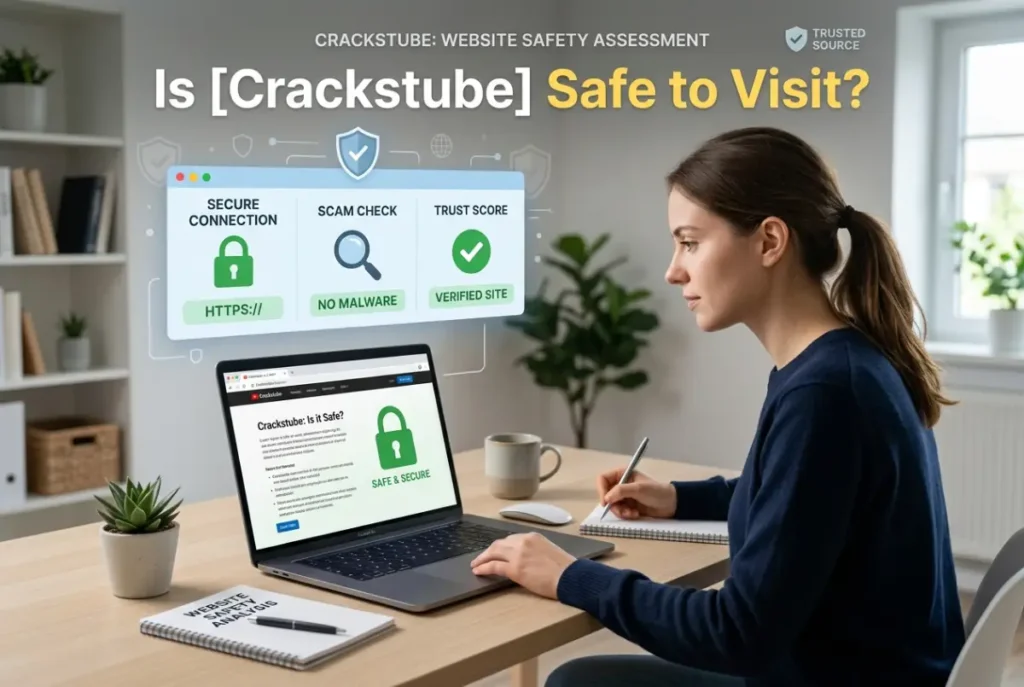
A third-party MalwareTips report dated November 3, 2026, described Crackstube.com as a long-standing WordPress publishing website. The saved report assigned it a score of 72 out of 100, categorized as low risk. It also reported that the website had a valid TLS certificate at the time of the check and was not flagged by the major browser threat feeds examined.
The same report recorded one suspicious antivirus observation out of 93 engines in an earlier saved analysis. The report treated that result as a cautionary signal rather than proof of an active malware infection.
These findings should be interpreted carefully. A security scan is a snapshot, not a permanent certification. A clean browser warning does not prove that every page, advertisement, link, or file is safe.
Visitors should take ordinary precautions:
- Confirm the complete domain before opening it.
- Keep the browser and operating system updated.
- Use reputable antivirus or endpoint protection.
- Avoid unfamiliar download buttons.
- Do not install browser extensions simply because a page requests it.
- Be cautious with pop-ups and unexpected redirects.
- Never enter sensitive information unless there is a clear reason and the website’s identity has been verified.
A website can be legitimate while still linking to third-party pages that deserve separate checks. Evaluate each destination independently.
7. Privacy Considerations
Privacy is not only about whether a website contains harmful software. It is also about what information a visitor shares and how that information may be handled.
When using any publishing website, consider whether it asks for an email address, account registration, newsletter subscription, payment details, or other personal information.
Before submitting information, read the privacy policy. Look for explanations of:
- What personal information may be collected.
- Whether cookies or analytics tools are used.
- How information may be stored.
- Whether information is shared with service providers.
- How users can contact the operator about privacy questions.
- Whether visitors can request changes or deletion where applicable.
A privacy policy should be specific enough to explain the website’s practices. A generic policy that does not identify the relevant operator or describe data handling clearly may leave important questions unanswered.
You can also reduce unnecessary exposure by limiting the information you share. Do not provide payment details, passwords, identity information, or sensitive personal data simply to read an ordinary article.
8. Is It a Software Download or Streaming Platform?
This is an important distinction because the website’s name may suggest a service that its public description does not support.
The material reviewed for this article describes Crackstube.com as a digital publishing website. It does not establish that this specific domain operates a library of cracked applications or an authorized video streaming service.
A cracked application is a modified program that may bypass a developer’s payment, license, or security controls. Downloading such software can create several problems, including malware exposure, missing updates, data theft, and legal concerns.
Unofficial streaming websites can raise separate issues. They may offer copyrighted material without permission, use intrusive advertising, or redirect visitors to unrelated websites.
Do not assume that a page offering free downloads or videos belongs to the same operator as a publishing website with a similar name. Check the domain and avoid files or links that you cannot verify.
9. Legal Considerations for US Readers
People in the United States should understand the difference between reading publicly available articles and obtaining unauthorized copies of copyrighted material.
Reading a general-interest article on a publishing website is not the same activity as downloading an unlicensed copy of paid software or streaming copyrighted content without permission.
Copyright law protects many forms of creative work, including software, films, music, photographs, and written material. The rights involved depend on the content, the license, and how it is distributed or used.
Software licenses also matter. A program may be free to use under an open-source license, free for personal use, or available only through a paid subscription. Those conditions are not interchangeable.
If a website offers a paid application for free without a clear authorization from the developer, treat the offer carefully. The same applies to movies, television programs, and other protected media.
For general information about copyright, readers can consult the US Copyright Office. For software, the developer’s official website is usually the best place to confirm licensing and download options.
10. How to Evaluate the Quality of Its Articles
A website’s value depends heavily on the quality of its content. A large number of articles does not automatically make a publication reliable.
Readers can assess an article by checking several basic qualities.
Accuracy
Does the article make claims that can be checked? Important facts should be supported by reliable sources, especially when the subject involves money, technology, law, or health.
Author transparency
Does the page identify an author or editor? Author information can help readers understand who created the material and whether that person has relevant experience.
Publication date
Is the article current? Information about software, online services, prices, and regulations can become outdated quickly. A recent date does not guarantee accuracy, but an old date may signal that the information needs checking.
Original value
Does the article explain something clearly, provide useful examples, or answer a real question? Pages that repeat generic statements without adding meaningful information may not be worth much of a reader’s time.
Clear language
Good content should be easy to understand. Technical terms should be explained, paragraphs should stay focused, and headings should accurately describe the information that follows.
These standards can help readers evaluate any digital publication, including websites that cover several unrelated topics.
11. Potential Benefits of a Multi-Niche Publishing Website
A multi-niche publication can offer several practical benefits when its content is well researched and organized.
A range of subjects: Readers may find articles about technology, business, education, finance, and lifestyle in one place.
Easy information access: Online articles can be read through a browser without installing a dedicated application.
Topic discovery: A visitor who arrives for one subject may discover useful information in another category.
General learning: Clear guides can introduce readers to topics they have not explored before.
However, these are potential benefits of the publishing model, not proof that every article on a particular website meets a high standard. Readers should judge the actual pages they use.
12. Possible Limitations and Questions
There are also limitations to consider when evaluating a relatively unfamiliar publication.
Unclear brand identity
If a website does not clearly identify its operator, editorial team, or business details, visitors may find it difficult to assess accountability.
Mixed search results
Similar names can lead to confusion. A visitor may accidentally open an unrelated domain or rely on a review that discusses a different website.
Content quality may vary
A multi-topic website may publish articles across areas that require different types of expertise. A useful technology guide does not automatically establish expertise in finance, health, or law.
Limited independent information
A website’s own description is useful for understanding how it presents itself, but independent evidence is important when evaluating reputation, ownership, and reliability.
Changing website conditions
Pages, policies, advertisements, and security signals can change. A review written at one point in time may not accurately describe the site several months later.
These limitations do not automatically mean that a website is unsafe or unreliable. They simply show why readers should verify important details rather than relying on a name or a single review.
13. Safer Alternatives for Common Online Needs
The best alternative depends on what someone is actually trying to do. A reader looking for articles needs a different service from someone looking for free software or legal video streaming.
| What you need | Examples of established options |
|---|---|
| General articles and news | AP News, BBC, Reuters |
| Technology information | CNET, Ars Technica, official product documentation |
| Free and open-source software | LibreOffice, GIMP, VLC |
| Free ad-supported video | Tubi, Pluto TV, The Roku Channel |
| Software downloads | The developer’s official website or verified app store |
| Copyright information | US Copyright Office |
These services have different business models, content libraries, and availability rules. Check their official websites for current terms, regional access, and supported features.
For software, downloading directly from the developer is usually the clearest way to confirm that the installer is genuine. For video, use a service that has the rights to distribute the content in your region.
14. Practical Checklist Before Using an Unfamiliar Website
A few simple checks can help reduce unnecessary risk.
Check the URL. Make sure the spelling and domain extension match the website you intend to visit. Look out for extra words, unusual characters, and misleading variations.
Review the About page. Look for a clear explanation of the website’s purpose and the organization or person responsible for it.
Read the policies. Privacy and terms pages should explain the website’s practices in understandable language.
Check external reputation signals. Use reputable security tools and independent sources. Remember that a single score cannot guarantee safety.
Avoid unexpected downloads. Do not install files or browser extensions unless you know what they do and can verify their source.
Be careful with payment requests. Confirm the business identity, pricing, refund terms, and payment destination before making a transaction.
Use strong account security. If you create an account, use a unique password and enable multifactor authentication when available.
Keep your software updated. Current browsers and operating systems receive security fixes that help protect against known threats.
This checklist is useful for any unfamiliar site, whether it is a publishing platform, online store, streaming service, or software directory.
15. Who Might Find the Website Useful?
Based on its public description as a general-interest publishing platform, Crackstube.com may be relevant to readers who want to explore articles across several topics.
People researching technology or business subjects may find a multi-category publication worth browsing if it provides clear, accurate, and current information. Casual readers may also appreciate having different topics organized in one place.
However, readers looking specifically for licensed software downloads or a recognized streaming subscription should not assume that the domain provides those services. Its publicly described publishing purpose is different.
Writers and website owners considering a publishing opportunity should also verify the current contributor guidelines, editorial standards, fees, publication terms, and ownership details directly. Do not pay for a placement or send original work based only on an informal message or an unverified third-party claim.
16. Frequently Asked Questions
What is Crackstube?
The name appears in different online discussions, but public information about Crackstube.com describes it as a digital media publishing website with general-interest articles. Similar-name websites may be unrelated, so the exact domain matters.
Is Crackstube.com a software download website?
The information reviewed for this article does not establish that Crackstube.com operates a cracked-software library. Its public description identifies it as a publishing platform. Avoid assuming that other sites using a similar name are connected.
Is it a video streaming service?
The reviewed material does not establish that Crackstube.com is a dedicated streaming platform. Check the exact domain and its current public pages before relying on claims about its services.
Is the website safe?
A MalwareTips scan saved on November 3, 2026, classified the domain as low risk, while also recording one earlier suspicious antivirus observation. This is not a guarantee of safety. Security conditions can change, and visitors should use normal browsing precautions.
Does the website require registration?
Registration requirements can change. Check the current website to see whether an account is needed for the specific feature or content you want to access. Avoid sharing unnecessary personal information.
Can I trust every article published there?
No website should be trusted automatically. Check the author, publication date, references, and supporting evidence. For important financial, legal, medical, or technical decisions, compare the information with authoritative sources.
Why do search results describe different services?
Different websites and articles may use similar names or discuss the same keyword in different contexts. Search engines can display those pages together even when the domains have no shared ownership.
What should I do if a page offers an unfamiliar download?
Do not download or install the file until you can verify its source and purpose. Prefer official developer websites and trusted app stores, and scan files with reputable security software.
Conclusion
Understanding an unfamiliar website requires more than looking at its name. Public information about Crackstube.com describes a general digital publishing platform, while other online discussions use similar wording for unrelated streaming or software-download websites. That difference is the most important point for visitors to remember.
The available security information provides some reassuring signals, but it does not offer a permanent guarantee. A saved third-party scan reported a low-risk classification alongside one suspicious antivirus observation, which is a reason to remain careful rather than make an absolute judgment.
For US readers, the practical approach is to verify the complete domain, review the website’s policies, assess the quality of its articles, and avoid unverified downloads or unnecessary personal disclosures. When looking for software or video content, use official sources and services with clear licensing.
Ultimately, evaluate the specific website and the action you plan to take. A general publishing page, a file-download directory, and an unofficial streaming service are not the same thing, even when their names look alike.

Hobby & Animal Names
Leo Hartman has owned dogs, birds, and one very difficult goat. He writes the hobby and animal names content here. Before any name makes the list, he tries it out loud first, usually on his dog, to see if it actually sounds right.