
The Los Angeles Rams and Chicago Bears delivered an exciting NFC Divisional Round matchup on January 18, 2026, at Soldier Field in Chicago. The Rams won 20–17 in overtime, advancing to the NFC Championship Game after a hard-fought contest that featured big defensive plays, key rushing touchdowns, and a dramatic finish.
The game offered plenty for NFL fans to analyze. Rams running back Kyren Williams scored twice, quarterback Matthew Stafford managed the passing game without throwing an interception, and the Los Angeles defense intercepted Caleb Williams three times. Chicago gained more total yards and controlled possession for longer, but its turnovers proved costly.
This breakdown of the los angeles rams vs chicago bears match player stats covers the final score, quarterback performances, leading rushers, receiving numbers, defensive contributions, and the plays that decided the game.
Game Overview: Rams vs Bears
Los Angeles Rams
Road team
20
Chicago Bears
Home team
17
Date
January 18, 2026
Venue
Soldier Field
Competition
NFC Divisional Round
Final result
Rams won in OT
Source: Official Rams box score and game reporting.
The Rams scored first with a Kyren Williams rushing touchdown. Chicago responded in the second quarter, and the teams entered halftime tied at 10–10. Both offenses found the end zone again in the fourth quarter, but neither could create a winning margin before regulation ended.
In overtime, Rams kicker Harrison Mevis converted a 42-yard field goal to secure the 20–17 victory. The Rams’ defense had helped create the opportunity by intercepting Caleb Williams in overtime.
Team Statistics: Rams vs Bears
The overall numbers show why this game remained competitive until the final moments. Chicago produced more total offense, rushing yards, and time of possession. Los Angeles, however, protected the ball and made the most important defensive plays.
| Team statistic | Los Angeles Rams | Chicago Bears |
|---|---|---|
| Final score | 20 | 17 |
| Total yards | 340 | 417 |
| Passing yards, net | 229 | 257 |
| Rushing yards | 111 | 160 |
| Total plays | 77 | 81 |
| Yards per play | 4.4 | 5.1 |
| Time of possession | 32:26 | 39:15 |
| Turnovers lost | 0 | 3 |
| Sacks allowed | 4 | 0 |
| Third-down conversions | 5 of 16 | 9 of 19 |
| Fourth-down conversions | 1 of 1 | 3 of 6 |
*Source: Rams official box score and game statistics.
Chicago’s 417 total yards were 77 more than Los Angeles produced. The Bears also held the ball for nearly seven additional minutes. Those advantages usually help a team win, but football games are not decided by yardage alone.
The biggest difference was ball security. The Bears threw three interceptions, while the Rams finished without a turnover lost. Those extra possessions gave Los Angeles opportunities to survive its offensive struggles and ultimately win in overtime.
The Rams also had to handle four sacks, while Chicago’s offensive line did not allow a sack in the recorded team statistics. Even so, the Los Angeles defense found ways to disrupt the passing game by taking the ball away.
Quarterback Stats: Matthew Stafford vs Caleb Williams
The quarterback matchup was one of the most interesting parts of the game. Matthew Stafford and Caleb Williams both attempted 42 passes, but their results differed in a crucial area: turnovers.
| Passing statistic | Matthew Stafford (Rams) | Caleb Williams (Bears) |
|---|---|---|
| Completions | 20 | 23 |
| Pass attempts | 42 | 42 |
| Completion percentage | 47.6% | 54.8% |
| Passing yards | 258 | 257 |
| Passing touchdowns | 0 | 2 |
| Interceptions thrown | 0 | 3 |
| Sacks taken | 4 | 0 |
| Passer rating | 67.4 | — |
*Source: Official game box score. Caleb Williams’ passer rating is omitted here because it is not listed in the cited official box score.
Matthew Stafford’s performance
Stafford completed 20 of 42 passes for 258 yards and did not throw an interception. Although he failed to throw a touchdown, his ability to avoid turnovers helped the Rams remain in control of their chances.
His completion rate was below 50%, and four sacks limited the offense’s rhythm. The Bears’ defense made it difficult for Stafford to find easy passing opportunities, forcing Los Angeles to work for its yards.
Still, Stafford’s performance had an important advantage: he did not give Chicago extra possessions through interceptions. The Rams were able to rely on their running game and defense rather than asking their quarterback to win the contest through high-volume scoring.
For readers reviewing the los angeles rams vs chicago bears match player stats, Stafford’s 258 passing yards are worth considering alongside his zero interceptions. Passing yardage alone does not explain the full value of a quarterback’s performance.
Caleb Williams’ performance
Caleb Williams completed 23 of 42 passes for 257 yards, threw two touchdown passes, and was intercepted three times. His touchdown passes helped Chicago stay in the game, but the interceptions were a major setback.
Williams connected with D.J. Moore for a short touchdown in the second quarter. Later, he found Cole Kmet for a fourth-quarter touchdown that tied the score at 17–17 with just 18 seconds remaining in regulation.
Those plays showed Williams’ ability to deliver under pressure. However, his third interception came in overtime, ending a promising Chicago possession and allowing Los Angeles to regain the ball.
The key takeaway is that Williams produced two touchdown passes but also made three costly mistakes. In a playoff game decided by a field goal, that balance between production and turnovers made a substantial difference.
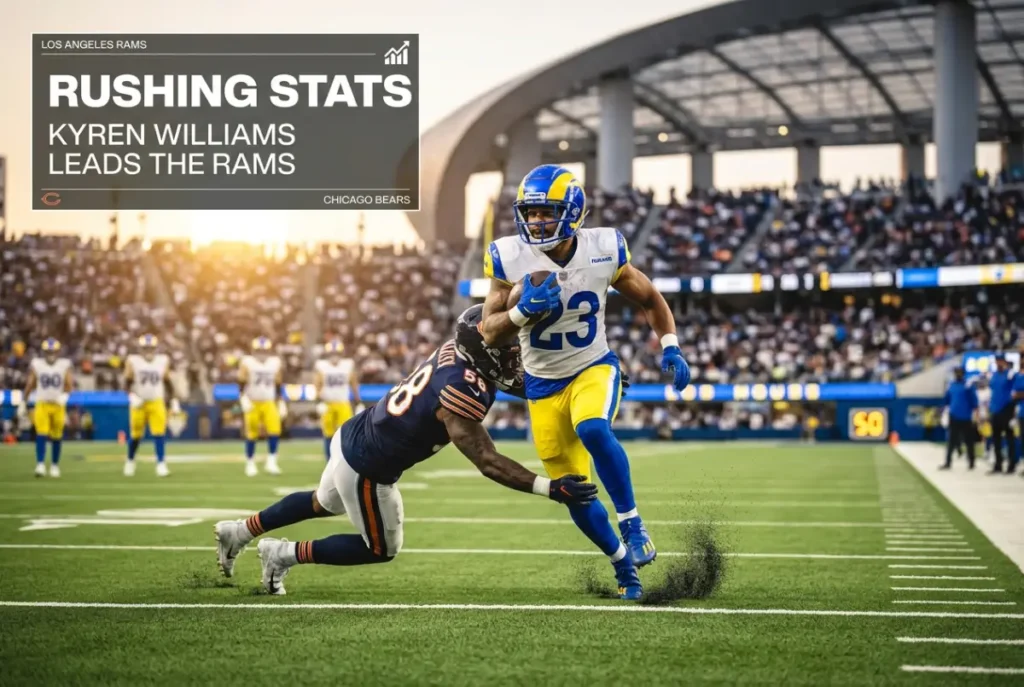
Rushing Stats: Kyren Williams Leads the Rams
The ground game was essential to Los Angeles’ victory. Kyren Williams scored both of the Rams’ touchdowns and gave the offense a dependable option when the passing game struggled.
Rams rushing statistics
| Player | Carries | Rushing yards | Average | Longest run | TDs |
|---|---|---|---|---|---|
| Kyren Williams | 21 | 87 | 4.1 | 10 | 2 |
| Blake Corum | 6 | 19 | 3.2 | 7 | 0 |
| Puka Nacua | 2 | 6 | 3.0 | 4 | 0 |
| Jordan Whittington | 1 | 0 | 0.0 | 0 | 0 |
| Matthew Stafford | 1 | -1 | -1.0 | -1 | 0 |
| Team total | 31 | 111 | 3.6 | 10 | 2 |
Kyren Williams: The Rams’ leading scorer
Williams carried the ball 21 times for 87 yards, averaging 4.1 yards per attempt. More importantly, he scored two rushing touchdowns, providing all of Los Angeles’ touchdowns during the game.
His first touchdown came on a four-yard run in the opening quarter. His second arrived on a five-yard run in the fourth quarter, giving the Rams a 17–10 lead.
Williams did not need a long breakaway run to make an impact. His value came from consistent carries and his ability to finish drives near the goal line. In a defensive playoff contest, those short-yardage touchdowns were especially important.
His contribution also reduced some of the pressure on Stafford, whose passing game struggled to find a consistent rhythm.
Blake Corum’s contribution
Corum recorded six carries for 19 yards. While he did not score, he provided additional running-back depth and helped the Rams distribute their rushing workload.
The Rams finished with 111 rushing yards, which was fewer than Chicago’s total. However, Los Angeles made its carries count when it mattered most by turning two of its rushing opportunities into touchdowns.
Chicago Bears rushing statistics
| Player | Carries | Rushing yards | Average | Longest run | TDs |
|---|---|---|---|---|---|
| D’Andre Swift | 19 | 76 | 4.0 | 13 | 0 |
| Caleb Williams | 5 | 40 | 8.0 | 26 | 0 |
| Kyle Monangai | 13 | 36 | 2.8 | 15 | 0 |
| D.J. Moore | 1 | 8 | 8.0 | 8 | 0 |
| Luther Burden III | 1 | 0 | 0.0 | 0 | 0 |
| Team total | 39 | 160 | 4.1 | 26 | 0 |
Chicago’s rushing attack was productive throughout the contest. D’Andre Swift led the Bears with 76 rushing yards on 19 carries, while Caleb Williams added 40 yards on five attempts.
Williams’ longest run covered 26 yards, making him a useful threat outside the pocket. Kyle Monangai contributed another 36 yards, giving Chicago multiple options on the ground.
Despite finishing with 160 rushing yards, the Bears did not score a rushing touchdown. That was a major contrast with the Rams, whose two rushing touchdowns helped determine the final result.
Receiving Stats: Rams vs Bears Wide Receivers and Tight Ends
Both teams had players make important catches, but neither passing offense produced a huge individual receiving performance. The receiving numbers show how the quarterbacks spread their targets and how different players contributed in short and intermediate areas of the field.
Los Angeles Rams receiving stats
| Player | Targets | Receptions | Receiving yards | Average per catch | Longest catch | TDs |
|---|---|---|---|---|---|---|
| Puka Nacua | 10 | 5 | 56 | 11.2 | 16 | 0 |
| Colby Parkinson | 7 | 3 | 56 | 18.7 | 35 | 0 |
| Jordan Whittington | 2 | 2 | 35 | 17.5 | 20 | 0 |
| Kyren Williams | 5 | 4 | 30 | 7.5 | 14 | 0 |
| Davante Adams | 6 | 2 | 24 | 12.0 | 12 | 0 |
| Tyler Higbee | 2 | 1 | 27 | 27.0 | 27 | 0 |
| Terrance Ferguson | 5 | 1 | 19 | 19.0 | 19 | 0 |
| Konata Mumpfield | 3 | 2 | 11 | 5.5 | 6 | 0 |
Puka Nacua’s role
Nacua finished with five catches for 56 yards on 10 targets. He tied for the Rams’ highest receiving-yard total and remained one of Stafford’s main options.
Although Nacua did not score, his involvement mattered because he attracted 10 targets. That workload indicates how frequently the Rams looked his way, even when the Bears limited his opportunities to produce bigger gains.
Colby Parkinson’s impact
Parkinson also recorded 56 receiving yards, making him one of the Rams’ most productive pass catchers. His three receptions averaged 18.7 yards, and his longest catch went for 35 yards.
That efficiency helped Los Angeles gain some valuable passing yardage despite its low completion rate. Parkinson’s production also showed that Stafford could find contributions beyond his primary wide receiver.
Jordan Whittington and the supporting receivers
Whittington caught both of his targets for 35 yards. Kyren Williams added four receptions for 30 yards, providing a short passing option out of the backfield.
Davante Adams finished with two catches for 24 yards, while Higbee caught one pass for 27 yards. The Rams’ receiving group was spread across several players rather than relying on one dominant performance.
The absence of a Rams receiving touchdown is notable. Both of their touchdowns came on the ground, which reinforces how important Williams’ rushing performance was to the final score.
Chicago Bears receiving stats
| Player | Targets | Receptions | Receiving yards | Average per catch | Longest catch | TDs |
|---|---|---|---|---|---|---|
| Colston Loveland | 10 | 4 | 56 | 14.0 | 23 | 0 |
| D.J. Moore | 8 | 5 | 52 | 10.4 | 34 | 1 |
| Rome Odunze | 6 | 2 | 44 | 22.0 | 27 | 0 |
| Kyle Monangai | 4 | 4 | 36 | 9.0 | 16 | 0 |
| Cole Kmet | 3 | 3 | 31 | 10.3 | 14 | 1 |
| Luther Burden III | 7 | 3 | 24 | 8.0 | 11 | 0 |
| Olamide Zaccheaus | 2 | 1 | 9 | 9.0 | 9 | 0 |
| Durham Smythe | 1 | 1 | 5 | 5.0 | 5 | 0 |
Chicago spread its passing production across several receivers. Loveland led the team with 56 receiving yards, while Moore added 52 yards and one touchdown. Odunze averaged 22 yards per reception, giving the Bears another effective downfield option.
Kmet caught three passes for 31 yards and scored Chicago’s late fourth-quarter touchdown. His reception tied the game at 17 and pushed the contest into overtime.
Moore’s touchdown and Kmet’s late score were crucial to Chicago’s comeback. Nevertheless, the Bears could not convert their overall offensive production into a winning result because the Rams defense made key plays at critical moments.
Defensive Stats: Interceptions Decide the Game
The Rams’ defense was the biggest reason Los Angeles escaped Chicago with a victory. The Bears moved the ball effectively, but three interceptions prevented their offense from taking full advantage of its yardage and possession advantages.
Key defensive performers
| Player | Team | Key contribution |
|---|---|---|
| Cobie Durant | Rams | 2 interceptions |
| Kam Curl | Rams | 1 interception, including the overtime takeaway |
| Caleb Williams | Bears | 3 interceptions thrown |
| Rams defense | Rams | 3 interceptions as a team |
| Bears defense | Bears | Pressured Stafford into 4 sacks |
Cobie Durant’s game-changing interceptions
Cornerback Cobie Durant recorded two interceptions, giving Los Angeles crucial defensive stops. His takeaways helped limit the damage from a Chicago offense that gained more than 400 total yards.
Interceptions can change a game even when they do not directly produce points. They stop an opponent’s drive, create a new possession, and can force the opposing quarterback to become more cautious.
Durant’s two interceptions were particularly valuable because the Bears were capable of sustaining drives through both the passing and rushing games.
Kam Curl’s overtime interception
Kam Curl made the decisive defensive play in overtime by intercepting Caleb Williams. The takeaway gave the Rams another opportunity to move into field-goal range, and Los Angeles capitalized on that opportunity.
The interception was the third by the Rams in the game. According to ESPN reporting, the team’s three interceptions were its most in a playoff game since the 2001 divisional round.
Curl’s contribution illustrates why defensive stats matter as much as offensive numbers. A quarterback may accumulate passing yards and touchdown passes, but a costly interception at the wrong time can outweigh those achievements.
How the Bears’ defense challenged Stafford
Chicago’s defense recorded four sacks against Stafford. The pressure made it difficult for Los Angeles to establish a smooth passing rhythm, and the Rams completed fewer than half of their pass attempts.
That defensive effort kept Chicago competitive even when its own offense made mistakes. The Bears also held Los Angeles to 340 total yards, well below Chicago’s offensive output.
The challenge for Chicago was maintaining that defensive pressure while avoiding the consequences of its own offensive turnovers. The Rams ultimately made better use of the decisive opportunities.
Quarter-by-Quarter Scoring Summary
The score remained close throughout the game, with each team responding to the other’s major scoring plays.
| Period | Los Angeles Rams | Chicago Bears |
|---|---|---|
| First quarter | 7 | 0 |
| Second quarter | 3 | 10 |
| Third quarter | 0 | 0 |
| Fourth quarter | 7 | 7 |
| Overtime | 3 | 0 |
| Final | 20 | 17 |
First quarter: Los Angeles strikes first
Kyren Williams opened the scoring with a four-yard rushing touchdown. The Rams took a 7–0 lead and established an early advantage by finishing a drive in the end zone.
Chicago’s offense could not answer with a score during the opening quarter, leaving the Bears to chase the game heading into the second period.
Second quarter: Chicago takes the lead
The Bears responded when Caleb Williams connected with D.J. Moore for a three-yard touchdown pass. Chicago then added a 48-yard field goal to move ahead 10–7.
The Rams tied the game with a 32-yard field goal from Harrison Mevis just before halftime. Both teams went into the break with 10 points, setting up a closely contested second half.
Third quarter: Defenses take over
Neither team scored in the third quarter. The lack of points reflected the defensive pressure and the difficulty both offenses had finding consistent scoring opportunities.
Chicago continued to gain yards, but the Rams remained within reach. Los Angeles also had to manage Stafford’s sacks and the Bears’ defensive pressure.
Fourth quarter: The game goes to overtime
Williams scored his second rushing touchdown of the day on a five-yard run, putting Los Angeles ahead 17–10.
Chicago refused to give up. With 18 seconds remaining, Caleb Williams threw a 14-yard touchdown pass to Cole Kmet. The extra point tied the game at 17–17 and sent the matchup into overtime.
Overtime: Rams finish the job
The decisive moment came when Curl intercepted Caleb Williams. Los Angeles then moved into a position to attempt a field goal, and Mevis made a 42-yard kick to secure the 20–17 win.
The finish highlighted the value of defensive discipline and reliable special teams. The Rams did not need another offensive touchdown; they needed one more successful scoring opportunity.
What the Player Stats Reveal About the Rams’ Win
Looking beyond the final score, several lessons stand out from the matchup.
1. Turnovers mattered more than total yardage
Chicago gained 417 yards compared with Los Angeles’ 340. The Bears also recorded more first downs and controlled possession for longer. Yet the Rams won because they avoided turnovers and intercepted Caleb Williams three times.
This is one of the clearest lessons from the game: offensive production must be supported by ball security. A team can move the ball effectively and still lose when turnovers repeatedly end promising drives.
2. Kyren Williams provided the scoring difference
The Rams did not have a passing touchdown, but Kyren Williams scored twice on the ground. His ability to finish short-yardage opportunities kept Los Angeles competitive while Stafford faced pressure.
The two rushing touchdowns were especially important in a game where both offenses struggled to produce consistent scoring drives.
3. Caleb Williams showed both promise and risk
Caleb Williams threw two touchdown passes and helped force overtime with a late scoring drive. His 40 rushing yards also added another dimension to Chicago’s attack.
However, the three interceptions overshadowed those positive contributions. The overtime interception was particularly damaging because it ended Chicago’s chance to take control of the game.
4. The Rams defense delivered in high-pressure moments
Los Angeles did not dominate every statistical category, but its defense delivered when the game was on the line. Durant’s two interceptions and Curl’s overtime takeaway were the most important defensive contributions.
A strong defensive performance is not always about preventing every first down or limiting every yard. Sometimes it is about creating turnovers at the exact moments when they can change the result.
5. Special teams provided the winning points
Harrison Mevis made both of his field-goal attempts, including the 42-yard overtime winner. His accuracy allowed the Rams to turn their final opportunity into a victory.
In close postseason games, dependable kicking can be the difference between advancing and going home.
Los Angeles Rams vs Chicago Bears Match Player Stats: Key Takeaways
The los angeles rams vs chicago bears match player stats show that this playoff game was decided by execution in crucial moments rather than overall offensive yardage. Chicago had more total yards, more rushing yards, and a longer time of possession, but Los Angeles made fewer costly mistakes.
Kyren Williams led the Rams’ scoring effort with 87 rushing yards and two touchdowns. Matthew Stafford threw for 258 yards without an interception, while Puka Nacua and Colby Parkinson each recorded 56 receiving yards.
For Chicago, Caleb Williams passed for 257 yards and two touchdowns, and D’Andre Swift led the rushing attack with 76 yards. D.J. Moore and Cole Kmet scored receiving touchdowns, but three interceptions ultimately proved too costly.
The Rams’ defensive performance, combined with Mevis’ accurate kicking, secured the 20–17 overtime victory. The result demonstrated how ball security, defensive takeaways, and successful execution in the final minutes can determine the outcome of a postseason matchup.
Frequently Asked Questions (FAQs)
1. What was the final score of the Rams vs Bears game?
The Los Angeles Rams defeated the Chicago Bears 20–17 in overtime in the NFC Divisional Round on January 18, 2026, at Soldier Field in Chicago.
2. How many passing yards did Matthew Stafford record?
Matthew Stafford completed 20 of 42 passes for 258 yards. He threw no touchdowns and no interceptions, and he was sacked four times.
3. How did Caleb Williams perform against the Rams?
Caleb Williams completed 23 of 42 passes for 257 yards, two touchdowns, and three interceptions. He also rushed five times for 40 yards. His late touchdown pass to Cole Kmet sent the game into overtime, but his overtime interception gave Los Angeles another opportunity to win.
4. Who was the leading rusher in the game?
Kyren Williams led the Rams with 87 rushing yards and two touchdowns on 21 carries. D’Andre Swift led Chicago with 76 yards on 19 carries.
5. Who led the Rams in receiving yards?
Puka Nacua and Colby Parkinson shared the Rams’ team lead with 56 receiving yards each. Nacua caught five passes, while Parkinson recorded three receptions. Neither scored a receiving touchdown.
6. Which Rams defenders intercepted Caleb Williams?
Cobie Durant recorded two interceptions, while Kam Curl added one, including the decisive overtime interception. The Rams finished with three interceptions as a team.
7. Who kicked the winning field goal?
Harrison Mevis kicked the winning 42-yard field goal in overtime, giving the Rams a 20–17 victory and sending them to the NFC Championship Game.
8. Why did the Rams win despite having fewer total yards?
The Rams gained 340 total yards compared with Chicago’s 417, but they avoided turnovers while intercepting Caleb Williams three times. Kyren Williams’ two rushing touchdowns and Mevis’ overtime field goal also played major roles in the victory.
9. Where can fans find the complete box score?
Fans can review the official team box score on the Los Angeles Rams’ game page for passing, rushing, receiving, and team statistics.
Final verdict: The Rams’ 20–17 overtime victory was a reminder that winning football requires more than gaining yards. Kyren Williams supplied the touchdowns, the defense created three interceptions, and Harrison Mevis delivered the decisive kick. Chicago showed plenty of offensive potential, but Los Angeles executed better when the game was on the line.

Hobby & Animal Names
Leo Hartman has owned dogs, birds, and one very difficult goat. He writes the hobby and animal names content here. Before any name makes the list, he tries it out loud first, usually on his dog, to see if it actually sounds right.