
The Golden State Warriors and LA Clippers delivered a competitive preseason matchup on October 4, 2026, with the Clippers earning a narrow 104–101 victory over the Warriors at the Stan Sheriff Center in Honolulu, Hawaii.
The three-point difference made this game an interesting early test for both teams. The Clippers produced a strong shooting performance from Rui Hachimura and Darius Garland, while Golden State received contributions from Charles Bassey, Brandon Williams, and Stephen Curry.
Fans searching for golden state warriors vs la clippers match player stats want to know which players scored the most points, who controlled the boards, how the teams performed from three-point range, and what the numbers reveal about the matchup.
This article breaks down the final score, leading performers, individual player statistics, team shooting numbers, and the main lessons from the game. Because this was a preseason contest, the results should be viewed as an early-season snapshot rather than a complete measure of either team’s regular-season strength.
Golden State Warriors vs LA Clippers Match Overview
Here are the key details from the October 4 matchup.
| Match Detail | Information |
|---|---|
| Teams | Golden State Warriors vs. LA Clippers |
| Date | October 4, 2026 |
| Competition | NBA preseason |
| Venue | Stan Sheriff Center |
| Location | Honolulu, Hawaii |
| Final Score | Warriors 101, Clippers 104 |
| Winning Team | LA Clippers |
| Winning Margin | 3 points |
| Warriors’ First-Quarter Score | 24 |
| Clippers’ First-Quarter Score | 23 |
| Warriors’ Total Rebounds | 49 |
| Clippers’ Total Rebounds | 52 |
| Warriors’ Three-Pointers Made | 6 |
| Clippers’ Three-Pointers Made | 11 |
The Clippers built their advantage with better three-point shooting and a slight edge in rebounding. Golden State stayed close throughout the contest, but the difference in perimeter efficiency proved important.
The Warriors made 37 of 95 field-goal attempts, while the Clippers converted 32 of 80. Golden State took more shots, but the Clippers made better use of their attempts and scored more efficiently from beyond the arc.
The final score also shows why individual statistics need to be considered alongside team performance. A player can post an impressive scoring total, but basketball games are often decided by several factors working together, including shooting efficiency, rebounds, turnovers, and free throws.
Golden State Warriors vs LA Clippers Match Player Stats: Top Performers
The following table highlights some of the leading individual performances from the preseason game.
Game Leaders
| Statistical Category | Golden State Warriors | LA Clippers |
|---|---|---|
| Leading Scorer | Charles Bassey — 12 points | Rui Hachimura — 21 points |
| Leading Rebounder | Yaxel Lendeborg — 9 rebounds | Cameron Christie — 8 rebounds |
| Leading Assists | Brandon Williams — 3 assists | Darius Garland — 6 assists |
| Team Rebounds | 49 | 52 |
| Team Assists | 23 | 18 |
| Three-Pointers Made | 6 | 11 |
| Turnovers | 16 | 22 |
Rui Hachimura led all players with 21 points, giving the Clippers a valuable scoring performance. Darius Garland added 15 points and six assists, helping create opportunities for teammates.
For Golden State, Charles Bassey led the team with 12 points and eight rebounds. Brandon Williams scored 11 points and recorded three assists, while several other Warriors contributed to the scoring effort.
These performances show that the game was not decided by one player alone. The Clippers benefited from efficient shooting, while Golden State had a broader collection of contributors but struggled to convert enough three-point attempts.
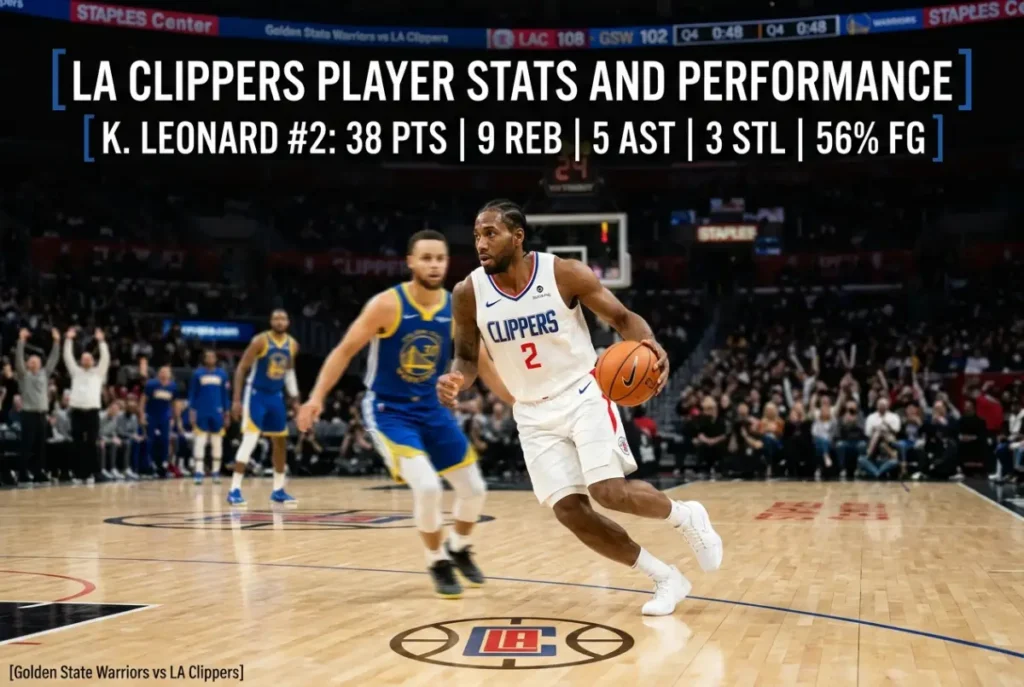
LA Clippers Player Stats and Performance
Rui Hachimura: The Game’s Leading Scorer
Rui Hachimura delivered the standout scoring performance for the Clippers, finishing with 21 points in 15 minutes and 12 seconds of playing time.
He made eight of 11 field-goal attempts and connected on four of five three-point attempts. His shooting accuracy helped the Clippers maintain their scoring advantage without needing a large number of possessions.
Hachimura’s performance was especially effective because he scored from different areas of the floor. His ability to convert both inside and outside the arc gave the Warriors’ defense several things to consider.
For a preseason game, an efficient performance like this can help a coaching staff evaluate offensive options and lineup combinations. However, one exhibition game is not enough to predict how a player will perform over an entire NBA season.
Darius Garland: Scoring and Playmaking
Darius Garland finished with 15 points, three rebounds, and six assists.
He shot four-for-four from the field and three-for-three from three-point range, making every field-goal attempt he recorded in the game. Garland also converted four of five free throws.
His six assists were the most among the players in this matchup. That number reflects his role in creating opportunities for teammates rather than focusing only on his own scoring.
Garland’s passing can be particularly valuable when the Clippers spread the floor and use movement to create open shots. His ability to recognize defensive gaps and deliver accurate passes can help establish a more organized offense.
The important takeaway is the combination of scoring efficiency and playmaking. Garland contributed directly to the offense in multiple ways, helping the Clippers secure the narrow win.
Keaton Wagler: An Important Scoring Contribution
Keaton Wagler recorded 15 points, six rebounds, and three assists for the Clippers.
He made three of 15 field-goal attempts, including one of 11 from three-point range, but converted eight of nine free throws.
His scoring total shows how free throws can contribute significantly to a player’s final numbers, even when shots from the field are not falling consistently.
Wagler also contributed on the boards and as a passer. Those additional statistics matter in preseason games, when teams are evaluating how players handle different responsibilities.
His shooting efficiency was not as strong as Hachimura’s or Garland’s, but his overall contribution still helped the Clippers maintain their offensive output.
Cameron Christie: Rebounding and Defensive Work
Cameron Christie finished with eight points, eight rebounds, and three assists.
He played 28 minutes and four seconds, giving him one of the longer appearances among the Clippers’ players. His eight rebounds tied him for the team’s leading individual total.
Rebounding is an important part of the game because it can end an opponent’s possession or create another scoring opportunity. Defensive rebounds help teams regain control, while offensive rebounds provide additional chances to score.
Christie’s contribution was not limited to the points column. His work on the boards and his passing helped the Clippers maintain a balanced team performance.
Blake Wesley and Other Clippers Contributors
Blake Wesley added eight points, three rebounds, and one assist. He also contributed defensively, recording a steal and a block.
Isaiah Jackson finished with four points, four rebounds, three assists, and three blocks. His defensive activity provided another useful contribution, particularly around the basket.
Baba Miller scored nine points and grabbed six rebounds, while Nick Martinelli added five points and two rebounds.
These supporting performances helped the Clippers build a team effort around their leading scorers. In preseason basketball, the contributions of bench players can be particularly important because coaches are assessing how different combinations perform together.
Golden State Warriors Player Stats and Performance
Charles Bassey: Golden State’s Leading Scorer
Charles Bassey led the Warriors with 12 points and eight rebounds.
He made six of 10 field-goal attempts, showing good efficiency around the basket. Although he did not make a three-pointer, his inside scoring helped Golden State remain competitive.
Bassey’s eight rebounds were also important. Rebounding can limit an opponent’s second-chance opportunities and help a team transition from defense to offense.
His performance offered Golden State a productive interior option. However, the Warriors needed more scoring efficiency from the perimeter to overcome the Clippers’ advantage from three-point range.
Brandon Williams: A Productive Bench Performance
Brandon Williams finished with 11 points, three assists, and two rebounds.
He made four of nine field-goal attempts and converted all three of his free throws. His scoring helped Golden State’s second unit maintain offensive pressure.
Williams also recorded one steal, adding a defensive contribution to his overall performance.
A productive backup guard can help a team maintain its pace when its primary ball handlers are resting. Williams’ combination of scoring and passing was a positive element of the Warriors’ performance.
Stephen Curry: Early Preseason Minutes
Stephen Curry recorded 10 points, two rebounds, and two assists in 12 minutes and 58 seconds.
He made three of four field-goal attempts, including two of three from three-point range, and converted both of his free throws.
Curry’s limited playing time is important when interpreting these numbers. Preseason rotations often differ from regular-season rotations, and a short appearance does not necessarily reflect a player’s expected role or workload once the season is underway.
His shooting numbers were efficient, but the limited minutes mean they should not be treated as a full-game performance.
For Warriors fans, Curry remains a player worth monitoring as the regular season develops. His perimeter shooting and ability to create scoring opportunities can influence how opposing defenses approach Golden State’s offense.
Graham Ike: A Useful Interior Contribution
Graham Ike scored 11 points and grabbed four rebounds.
He made three of seven field-goal attempts and converted five of five free throws. His ability to reach the line helped him build a double-digit scoring total despite not shooting particularly well from the field.
Ike also contributed defensively with two steals and one block. Those plays can help disrupt an opponent’s offense and create transition opportunities.
His performance was one of several contributions from the Warriors’ supporting cast. The team had enough individual scoring to remain close, but it needed more consistent perimeter shooting to take control.
Gui Santos and Gary Payton II
Gui Santos finished with nine points and four rebounds. He made three of seven field-goal attempts, including one three-pointer, and converted both of his free throws.
Gary Payton II scored six points and recorded two blocks. He made three of five field-goal attempts and added defensive activity around the basket.
Draymond Green recorded two points, two rebounds, two assists, three blocks, and no turnovers in his limited appearance. His defensive contributions were notable even though his scoring total was low.
These performances show that Golden State had contributions from multiple players. The main issue was turning that collective effort into more efficient team shooting.
Full Team Shooting Comparison
The team statistics explain several of the biggest differences between the Warriors and Clippers.
| Team Statistic | Warriors | Clippers |
|---|---|---|
| Final Score | 101 | 104 |
| Field Goals Made | 37 | 32 |
| Field-Goal Attempts | 95 | 80 |
| Field-Goal Percentage | 38.9% | 40.0% |
| Three-Pointers Made | 6 | 11 |
| Three-Point Attempts | 33 | 36 |
| Three-Point Percentage | 18.2% | 30.6% |
| Free Throws Made | 21 | 29 |
| Free-Throw Attempts | 31 | 38 |
| Free-Throw Percentage | 67.7% | 76.3% |
| Total Rebounds | 49 | 52 |
| Assists | 23 | 18 |
| Turnovers | 16 | 22 |
The most obvious difference is three-point shooting. Golden State made six three-pointers, while the Clippers made 11.
That five-shot difference from beyond the arc represents 15 additional points from three-pointers for the Clippers compared with the Warriors. It was a major factor in a game decided by only three points.
The Clippers also made eight more free throws. Their 29 made free throws compared with Golden State’s 21 helped offset the Warriors’ advantage in total field goals made.
Golden State recorded more assists and committed fewer turnovers, but those advantages were not enough to overcome the shooting gap.
The numbers demonstrate an important basketball principle: taking more shots does not automatically lead to more points. Shot quality, shooting accuracy, and the value of each attempt matter just as much.
Why the Clippers Won the Game
The Clippers’ 104–101 victory came down to several important factors.
1. Better Three-Point Shooting
The Clippers made 30.6% of their three-point attempts, compared with Golden State’s 18.2%.
Although neither team had an outstanding overall three-point percentage, the Clippers converted five more shots from deep. That difference was significant in a close contest.
2. More Points at the Free-Throw Line
The Clippers made 29 free throws, while the Warriors made 21.
Free throws provide opportunities to score without needing a field-goal attempt. The Clippers took advantage of those opportunities and gained an eight-point advantage in made free throws.
3. Strong Individual Efficiency
Hachimura’s 21 points on eight-for-11 shooting and Garland’s perfect field-goal performance gave the Clippers two efficient scoring options.
These performances helped the team produce 104 points despite attempting 15 fewer field goals than Golden State.
4. A Small Rebounding Advantage
The Clippers finished with 52 rebounds compared with Golden State’s 49.
The difference was not large, but controlling the boards can help teams manage possessions and prevent opponents from gaining extra scoring opportunities.
5. Effective Supporting Players
Christie, Miller, Wesley, and Jackson all contributed in different ways. Their rebounds, defensive plays, and scoring helped the Clippers maintain their advantage.
The final result was not based on one statistic alone. It came from a combination of shooting, free throws, rebounding, and contributions across the lineup.
Why the Warriors Fell Short
Golden State’s loss also offers several lessons from the statistical breakdown.
Perimeter Shooting Was the Biggest Problem
The Warriors attempted 33 three-pointers but made only six. That 18.2% success rate limited their ability to take advantage of the extra shots they attempted.
Making even a few more three-pointers could have changed the final result.
More Field-Goal Attempts Did Not Produce More Points
Golden State attempted 95 field goals, 15 more than the Clippers. However, the Warriors’ field-goal percentage was 38.9%, slightly below the Clippers’ 40.0%.
The Warriors created more shooting opportunities but were less effective overall from the field.
Free-Throw Efficiency Left Points Available
Golden State made 21 of 31 free throws, a 67.7% conversion rate.
The missed free throws mattered because the game was decided by only three points. Improving at the line could make a difference in similarly close contests.
Bench Production Was Not Enough
The Warriors received contributions from Bassey, Williams, Ike, Santos, and other players. However, the team still needed more efficient scoring from outside to win.
Preseason results should not be overinterpreted, but the game provides a useful reminder that scoring balance and shot selection are important for any lineup.
Head-to-Head Context: Warriors vs Clippers
The October 4 preseason game was not the only important recent meeting between these teams.
On April 15, 2026, Golden State defeated the Clippers 126–121 in the NBA Play-In Tournament. Curry scored 35 points in that game, leading a strong second-half performance by the Warriors.
The contrast between the two results is worth noting. Golden State won the more consequential April matchup, while the Clippers won the October preseason contest.
The games also served different purposes. The April contest determined which team advanced in the postseason, while the October game offered an opportunity to evaluate players and rotations before the regular season.
Fans should avoid treating the preseason result as a direct prediction of how the teams will perform in a future competitive matchup. Player availability, minutes, tactical decisions, and team rotations can differ considerably.
What These Player Stats Mean for the Regular Season
Preseason box scores can help fans identify promising performances, but they need to be interpreted carefully.
For the Clippers, Hachimura’s efficient shooting and Garland’s playmaking were positive signs in this game. Christie and several supporting players also contributed on the boards and defensively.
For Golden State, Bassey’s inside scoring and Williams’ contribution off the bench were encouraging. Curry also showed efficient shooting in a limited appearance.
However, one game cannot establish a player’s long-term role or predict future production. Preseason minutes may be limited, and coaches often use different lineups to evaluate players.
A stronger assessment requires multiple games, consistent minutes, player availability, and regular-season statistics.
For fans following fantasy basketball, the most useful numbers are usually those supported by a stable role and repeated production. A single high-scoring preseason performance may be worth monitoring, but it should not be the only factor in a fantasy decision.
Frequently Asked Questions
Who won the latest Warriors vs Clippers preseason game?
The LA Clippers defeated the Golden State Warriors 104–101 on October 4, 2026, in a preseason game played in Honolulu, Hawaii.
Who scored the most points in the game?
Rui Hachimura led all players with 21 points for the Clippers. He made eight of 11 field-goal attempts, including four three-pointers.
How many points did Stephen Curry score?
Stephen Curry scored 10 points in 12 minutes and 58 seconds. He made three of four field-goal attempts and two of three three-point attempts.
Who led the Warriors in scoring?
Charles Bassey led Golden State with 12 points. He also recorded eight rebounds and made six of 10 field-goal attempts.
Who recorded the most assists?
Darius Garland led the game with six assists. Brandon Williams recorded three assists for Golden State.
Which team shot better from three-point range?
The Clippers shot 30.6% from three-point range, making 11 of 36 attempts. The Warriors shot 18.2%, making six of 33 attempts.
Did the Warriors win the previous competitive matchup?
Yes. Golden State defeated the Clippers 126–121 in the April 15, 2026, NBA Play-In Tournament game. Curry scored 35 points in that contest.
Where can fans find official NBA player stats?
Fans can check the NBA’s official website or ESPN’s game coverage for box scores, individual player statistics, team shooting percentages, rebounds, assists, and other game details.
Final Thoughts
The October 4 preseason matchup between Golden State and the LA Clippers was a close contest that highlighted the importance of shooting efficiency and team contributions. The Clippers won 104–101, led by Rui Hachimura’s 21 points and Darius Garland’s 15 points and six assists.
Golden State received productive performances from Charles Bassey and Brandon Williams, while Stephen Curry scored 10 points in limited minutes. The Warriors also recorded more assists and fewer turnovers, but their three-point shooting proved costly.
For readers tracking golden state warriors vs la clippers match player stats, the biggest takeaway is the difference between individual production and overall team efficiency. The Clippers made five more three-pointers and eight more free throws, giving them enough scoring to secure the narrow win.
As the regular season progresses, future matchups will provide a clearer picture of each team’s strengths, player roles, and ability to perform under competitive conditions. The October preseason box score is a useful starting point, but regular-season results will offer the more meaningful measure of both teams.

Hobby & Animal Names
Leo Hartman has owned dogs, birds, and one very difficult goat. He writes the hobby and animal names content here. Before any name makes the list, he tries it out loud first, usually on his dog, to see if it actually sounds right.