
The Philadelphia Eagles and Buffalo Bills are two of the NFL’s most recognizable teams, with passionate fan bases, talented rosters, and ambitions of competing for a Super Bowl title. When these teams meet, the matchup brings together physical football, explosive offensive playmakers, and defenses capable of changing the game.
Fans searching for Eagles vs Bills want to understand how the teams compare, which players could make the biggest impact, and what each side would need to do to win. Philadelphia is known for its physical offensive line, versatile quarterback Jalen Hurts, and powerful rushing attack. Buffalo relies on quarterback Josh Allen, who combines strong passing ability with dangerous running skills.
Both teams have the talent to create problems for opposing defenses. However, their approaches are different enough to make a meeting between them especially interesting.
This article breaks down the key players, offensive and defensive matchups, statistical categories to watch, and the factors that could determine the outcome of a future contest. Because no Philadelphia-Buffalo game is currently listed on the published 2026 regular-season schedules, this is a matchup analysis rather than a report of a scheduled game or a prediction based on confirmed game-day lineups.
Eagles vs Bills Match Details
The following table summarizes the basic matchup information.
| Match Detail | Information |
|---|---|
| Home Team | Philadelphia Eagles or Buffalo Bills, depending on the venue |
| Away Team | Philadelphia Eagles or Buffalo Bills, depending on the venue |
| League | National Football League (NFL) |
| Philadelphia’s Conference | NFC |
| Buffalo’s Conference | AFC |
| Philadelphia’s Division | NFC East |
| Buffalo’s Division | AFC East |
| Philadelphia’s Home Stadium | Lincoln Financial Field |
| Buffalo’s Home Stadium | Highmark Stadium |
| Main Quarterback Matchup | Jalen Hurts vs. Josh Allen |
| Primary Game Factors | Turnovers, rushing efficiency, quarterback pressure, and red-zone scoring |
Philadelphia and Buffalo belong to different conferences, so they do not meet as regularly as division rivals. Their games can therefore offer an interesting comparison between two teams built around different offensive strengths.
The venue also matters. Philadelphia’s home crowd can create a challenging environment for visiting offenses, while Buffalo’s cold-weather conditions can become a factor during late-season games. Neither setting guarantees a win, but both can influence preparation and execution.

Philadelphia Eagles Team Overview
The Eagles have built their identity around physical offensive line play, a powerful rushing attack, and a defense that can apply pressure from multiple positions.
Their offense can create problems in several ways. Philadelphia can run between the tackles, use quarterback movement to create extra rushing opportunities, or attack downfield when defenses focus too heavily on the ground game.
This balance makes the Eagles difficult to defend. Opponents cannot concentrate exclusively on the passing game without risking substantial rushing gains. At the same time, committing too many defenders to stopping the run can create passing opportunities for Hurts and his receivers.
Jalen Hurts Leads the Offense
Jalen Hurts is central to Philadelphia’s offensive approach. He can make accurate throws from the pocket, extend plays under pressure, and gain yards with his legs.
His rushing ability is especially important near the goal line. When the Eagles use designed quarterback runs or short-yardage formations, the defense must account for Hurts as a runner as well as a passer.
That extra responsibility can open running lanes for Philadelphia’s backs and create opportunities for receivers.
Hurts’ decision-making is another key factor. Against a defense that can generate pressure, he needs to recognize coverage quickly and avoid forcing passes into crowded areas. Protecting the football is particularly important against a Buffalo team that can turn interceptions into immediate scoring opportunities.
Saquon Barkley and the Rushing Attack
Running back Saquon Barkley gives Philadelphia an explosive option in the backfield. He can gain yards through contact, find openings between the tackles, and turn a small gap into a long run.
Barkley’s effectiveness often depends on the offensive line’s ability to create space. When Philadelphia wins at the line of scrimmage, its running game becomes more difficult to predict.
The Eagles can also use Barkley to control the tempo. Long rushing drives keep the opposing offense on the sideline and help reduce the number of possessions in a game.
Against Buffalo, Philadelphia would benefit from establishing the run early. Doing so could force the Bills to bring additional defenders closer to the line of scrimmage, creating more opportunities for Hurts to throw downfield.
A.J. Brown and DeVonta Smith
Philadelphia’s receiving game features two major threats in A.J. Brown and DeVonta Smith.
Brown brings physical strength, contested-catch ability, and the potential to gain significant yards after a reception. His presence can force defensive backs to play more cautiously, particularly when he receives favorable matchups against individual defenders.
Smith offers a different skill set. His route-running and ability to create separation make him valuable on short, intermediate, and deep routes.
Together, the two receivers give Hurts multiple ways to attack a defense. Brown can challenge defenders physically, while Smith can exploit coverage gaps and create opportunities through precise route-running.
Buffalo would need to communicate effectively in the secondary and prevent either receiver from gaining too much separation. Double coverage on one player could leave the other with a more favorable matchup.
Buffalo Bills Team Overview
Buffalo’s offense is built around the versatility of Josh Allen. His ability to make difficult throws, escape pressure, and gain rushing yards gives the Bills a flexible offensive identity.
Allen can attack defenses from the pocket or create opportunities when a play breaks down. His combination of arm strength and mobility means defenders must remain disciplined even when they appear to have him contained.
The Bills also benefit from an offensive approach that can use different formations and distribute the ball among several receiving options.
Josh Allen: Buffalo’s Biggest Offensive Weapon
Josh Allen is the player most likely to shape Buffalo’s offensive performance in a matchup against Philadelphia.
He can make deep throws, deliver passes into tight windows, and use his legs when defenses leave space in front of him. His physical style also makes him a threat in short-yardage and goal-line situations.
Allen’s mobility creates a challenge for opposing defenses. If Philadelphia’s pass rush moves too aggressively toward him, he may escape through an open lane. If defenders focus on containing him, they may give him more time to find receivers.
However, Allen must balance aggression with smart decision-making. Deep throws can produce explosive plays, but forcing passes into tight coverage can lead to interceptions.
Against Philadelphia, his best approach would be to take advantage of open passing lanes while using his rushing ability selectively. Consistent decisions could help Buffalo sustain drives and keep its offense productive.
James Cook and the Bills’ Running Game
James Cook is an important part of Buffalo’s offensive balance. His speed and ability to find space make him a dangerous option when the offensive line creates running lanes.
Cook can contribute on outside runs, inside handoffs, and plays designed to get him into open space. His receiving ability can also give Allen an option when the defense pressures the quarterback.
Buffalo would benefit from establishing Cook early rather than asking Allen to carry the entire offense.
An effective running game can slow down Philadelphia’s pass rush, create manageable third downs, and make play-action passes more effective. If Cook consistently gains positive yardage, Buffalo can force the Eagles to respect both the run and the pass.
Buffalo’s Receiving Options
Buffalo’s passing attack has featured receivers such as Khalil Shakir and other playmakers who can contribute through different route combinations.
Shakir can be valuable on short and intermediate routes, where his ability to gain yards after the catch helps Buffalo maintain offensive momentum. Other receivers can stretch the field and create opportunities when defenses focus on the middle.
Tight ends can also play an important role by providing dependable targets in crowded areas, especially on third downs and near the goal line.
Against Philadelphia, Buffalo would need to distribute targets effectively. Relying on one receiver would allow the Eagles to concentrate their coverage and make the offense easier to defend.
Because rosters, injuries, and player roles change during an NFL season, the latest team reports should be checked before treating any individual player as a confirmed starter.
Eagles vs Bills: Offensive Comparison
Philadelphia and Buffalo both have quarterbacks who can make plays with their arms and legs. However, the teams emphasize different strengths.
| Category | Philadelphia Eagles | Buffalo Bills |
|---|---|---|
| Quarterback | Jalen Hurts | Josh Allen |
| Offensive Identity | Physical, balanced attack | Versatile passing and rushing attack |
| Primary Rushing Threat | Saquon Barkley | James Cook |
| Leading Receiving Threats | A.J. Brown and DeVonta Smith | Khalil Shakir and other receiving options |
| Key Strength | Offensive line and rushing game | Quarterback versatility |
| Main Offensive Challenge | Protecting the ball and sustaining drives | Avoiding turnovers and handling pressure |
| Important Factor | Establishing the run | Creating explosive plays |
Philadelphia’s offensive line can help the team control the pace of a game. If the Eagles consistently gain yards on the ground, they can reduce the pressure on Hurts and keep Buffalo’s defense from focusing entirely on the pass.
Buffalo’s biggest advantage is Allen’s ability to create plays in different situations. He can attack downfield, extend a play outside the pocket, or gain yards on a designed run.
The team that controls the line of scrimmage and avoids costly mistakes could gain the upper hand.
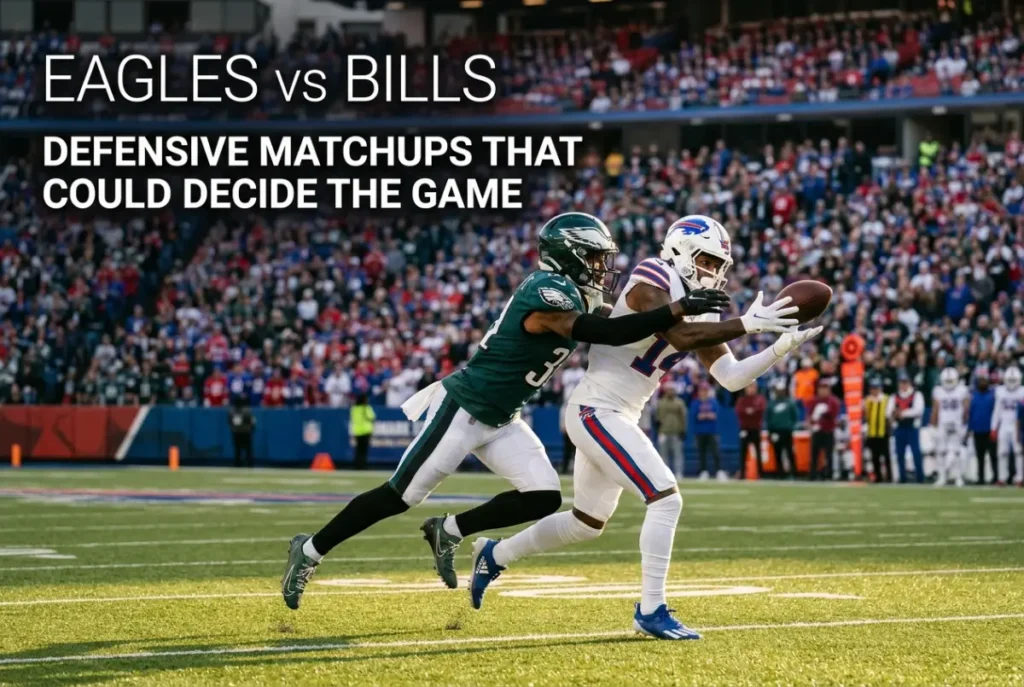
Defensive Matchups That Could Decide the Game
Offensive stars often attract the most attention, but defense could determine which team wins a close contest.
Philadelphia’s Defense Against Josh Allen
The Eagles would need to pressure Allen while keeping him inside the defensive structure.
A strong pass rush can force quicker throws and disrupt the timing of Buffalo’s offense. However, rushing too aggressively could create escape lanes that allow Allen to gain significant yards.
Philadelphia’s linebackers and defensive backs would need to communicate effectively, especially when Allen moves outside the pocket. Defenders must remain aware of receivers while preventing him from scrambling for easy first downs.
The Eagles should also aim to limit explosive passing plays. Allowing Buffalo to gain large chunks of yardage quickly could put Philadelphia’s defense under pressure and shorten the time available to make adjustments.
Buffalo’s Defense Against Jalen Hurts
Buffalo faces a different challenge when defending Hurts.
The Bills must account for Philadelphia’s running backs, quarterback runs, and passing options at the same time. If they commit too many defenders to stopping Barkley, Hurts may find open receivers. If they focus on coverage, Philadelphia could exploit gaps in the running game.
Discipline is especially important near the goal line. Hurts can create rushing opportunities in short-yardage situations, so defenders need to maintain their assignments and tackle effectively.
Buffalo should also try to force Philadelphia into long third-down situations. If the Eagles are consistently facing third-and-long, the Bills can use more predictable passing situations to generate pressure.
Key Player Matchups to Watch
Several individual matchups could influence the result of a future meeting.
1. Jalen Hurts vs. Buffalo’s Pass Rush
Hurts must recognize pressure quickly and make accurate decisions. If Buffalo can pressure him without sacrificing coverage, Philadelphia may struggle to sustain drives.
However, if Hurts escapes the pocket and extends plays, the Bills could be forced to defend for longer than expected.
2. Josh Allen vs. Philadelphia’s Secondary
Allen’s arm strength gives Buffalo the ability to attack downfield. Philadelphia’s defensive backs must avoid giving receivers too much space and should be prepared for Allen to scramble when passing lanes close.
The Eagles will need to combine sound coverage with disciplined quarterback containment.
3. Saquon Barkley vs. Buffalo’s Front Seven
Barkley’s running ability could help Philadelphia control possession. Buffalo must limit the space available to him and prevent him from consistently reaching the second level of the defense.
Stopping Barkley early would allow the Bills to concentrate more attention on Hurts and the passing game.
4. James Cook vs. Philadelphia’s Run Defense
Cook’s speed makes him dangerous when he reaches open space. Philadelphia needs to tackle effectively and prevent outside runs from turning into explosive gains.
If the Eagles contain Cook, Buffalo may face more difficult passing situations.
5. A.J. Brown and DeVonta Smith vs. Buffalo’s Secondary
Philadelphia’s receivers can challenge defensive backs in different ways. Brown’s physicality and Smith’s route-running ability create a difficult coverage assignment.
Buffalo needs to prevent easy completions while limiting yards after the catch.
Important Team Statistics to Follow
When analyzing this matchup, several statistical categories provide more useful information than the final score alone.
Passing efficiency: Completion percentage, yards per attempt, touchdowns, and interceptions show how effectively each quarterback moves the ball.
Rushing efficiency: Yards per carry and successful early-down runs reveal whether a team can control the line of scrimmage.
Third-down conversions: Teams that convert third downs can sustain drives, increase time of possession, and create more scoring opportunities.
Red-zone performance: Reaching the opponent’s 20-yard line is valuable, but teams must finish those drives with touchdowns or field goals.
Turnover differential: Interceptions and fumbles can change momentum quickly. Protecting the ball is essential in a matchup between two talented offenses.
Sacks and quarterback pressure: Pressure can disrupt passing rhythm and force quarterbacks to make difficult decisions.
Penalties: Holding, pass interference, and unnecessary defensive penalties can extend drives or erase important gains.
Time of possession: A team that maintains long drives can limit the opponent’s opportunities, although possession time alone does not guarantee victory.
These numbers help explain the way a game develops and which team is executing its plan more effectively.

Eagles vs Bills: Who Has the Advantage?
A matchup between Philadelphia and Buffalo would be difficult to predict without confirmed rosters, injury reports, venue details, and current team statistics.
Philadelphia could have an advantage if it controls the rushing game and allows Hurts to operate behind a strong offensive line. Barkley’s running ability, combined with Brown and Smith as receiving threats, would give the Eagles multiple ways to move the football.
Buffalo could gain the upper hand if Allen creates explosive plays while Cook provides a dependable rushing option. A productive ground game would make the Bills less predictable and help protect Allen from constant defensive pressure.
The most important factors would likely be:
- Which team controls the line of scrimmage.
- Which quarterback makes fewer costly mistakes.
- Whether Philadelphia can contain Allen’s rushing ability.
- Whether Buffalo can slow Barkley and Hurts on the ground.
- Which defense performs better in the red zone.
- Whether either team creates a significant turnover advantage.
Home-field advantage could also matter. Crowd noise, travel, weather, and familiarity with the stadium can influence communication and preparation.
Rather than naming a guaranteed winner, the more useful approach is to evaluate how the two teams match up and identify which factors would most likely determine the result.
Head-to-Head History
Philadelphia and Buffalo have faced each other in several memorable NFL games, including regular-season contests and matchups featuring major offensive performances.
One notable recent meeting took place on November 26, 2023, when Philadelphia defeated Buffalo 37–34 in overtime. The game featured a strong offensive performance from both sides and highlighted how difficult it can be to contain two quarterbacks with significant passing and rushing ability.
Philadelphia rallied late to force overtime before securing the victory. The result demonstrated the importance of finishing drives, making key defensive stops, and remaining composed in pressure situations.
Historical results provide context, but they do not determine the outcome of a future game. Coaching staffs, rosters, player health, and offensive strategies can change significantly between seasons.
The most useful lesson from previous meetings is that both teams can create scoring opportunities quickly. Defensive execution and turnovers may be just as important as offensive talent when the teams meet again.
Frequently Asked Questions
1. Who is the quarterback for the Philadelphia Eagles?
Jalen Hurts is Philadelphia’s quarterback. He combines passing ability with rushing skills, making him an important part of the Eagles’ offensive system.
2. Who is the quarterback for the Buffalo Bills?
Josh Allen is Buffalo’s quarterback. He is known for his arm strength, ability to throw deep passes, and mobility when escaping pressure.
3. Which running backs are important in this matchup?
Saquon Barkley is a key running back for Philadelphia, while James Cook is an important part of Buffalo’s rushing attack. Both players can contribute to their teams’ passing games as well.
4. Who are Philadelphia’s main receiving threats?
A.J. Brown and DeVonta Smith are two of Philadelphia’s primary wide receivers. Brown brings physicality and contested-catch ability, while Smith is known for his route-running and ability to create separation.
5. When do the Eagles play the Bills in 2026?
The published 2026 regular-season schedules do not currently list a Philadelphia Eagles-Buffalo Bills matchup. Fans should check the official NFL schedules for any future announcements or schedule changes.
6. What is the biggest factor in an Eagles-Bills game?
Quarterback performance, rushing efficiency, and turnovers are likely to be major factors. Philadelphia may look to establish the run, while Buffalo could rely on Allen’s versatility to create scoring opportunities.
7. Where can fans find official team statistics?
Fans can find schedules, box scores, player statistics, injury reports, and team news on the official NFL website and the Philadelphia Eagles and Buffalo Bills team websites.
Final Thoughts
A meeting between Philadelphia and Buffalo would bring together two talented NFL teams with different but effective offensive approaches. The Eagles can use their physical rushing attack and versatile quarterback to control the game, while the Bills can rely on Allen’s passing and rushing ability to create explosive plays.
The most important Eagles vs Bills storylines would center on quarterback performance, the battle in the trenches, and each defense’s ability to limit big plays. Barkley and Cook could influence the pace of the game, while Brown and Smith would give Philadelphia important passing options.
For Buffalo, protecting Allen and creating opportunities for its receiving group would be essential. For Philadelphia, maintaining offensive balance and containing Allen’s mobility could make the difference.
Ultimately, the outcome of a future matchup would depend on preparation, execution, player availability, and performance on game day. Looking at these factors provides a clearer understanding of how the two teams compare and what fans should watch when they meet again.

Hobby & Animal Names
Leo Hartman has owned dogs, birds, and one very difficult goat. He writes the hobby and animal names content here. Before any name makes the list, he tries it out loud first, usually on his dog, to see if it actually sounds right.