
The Los Angeles Chargers and Las Vegas Raiders renewed their AFC West rivalry on September 20, 2026, at SoFi Stadium in Inglewood, California. The Raiders came away with a 26–14 victory, using an effective passing attack, timely scoring plays, and defensive pressure to earn the win. The result gave Las Vegas a strong start to its divisional campaign while leaving the Chargers searching for answers after another difficult performance.
For fans researching los angeles chargers vs las vegas raiders match player stats, the final score tells only part of the story. Kirk Cousins delivered three touchdown passes for the Raiders, Tre Tucker produced a big receiving performance, and Cody White scored twice through the air. On the Chargers’ side, Omarion Hampton led the rushing attack, Justin Herbert threw for 192 yards, and Oronde Gadsden II contributed a receiving touchdown.
This article breaks down the final score, passing statistics, rushing production, receiving leaders, defensive impact, and key moments that shaped the contest. It also explains which numbers mattered most and what the performance could mean for both teams moving forward.
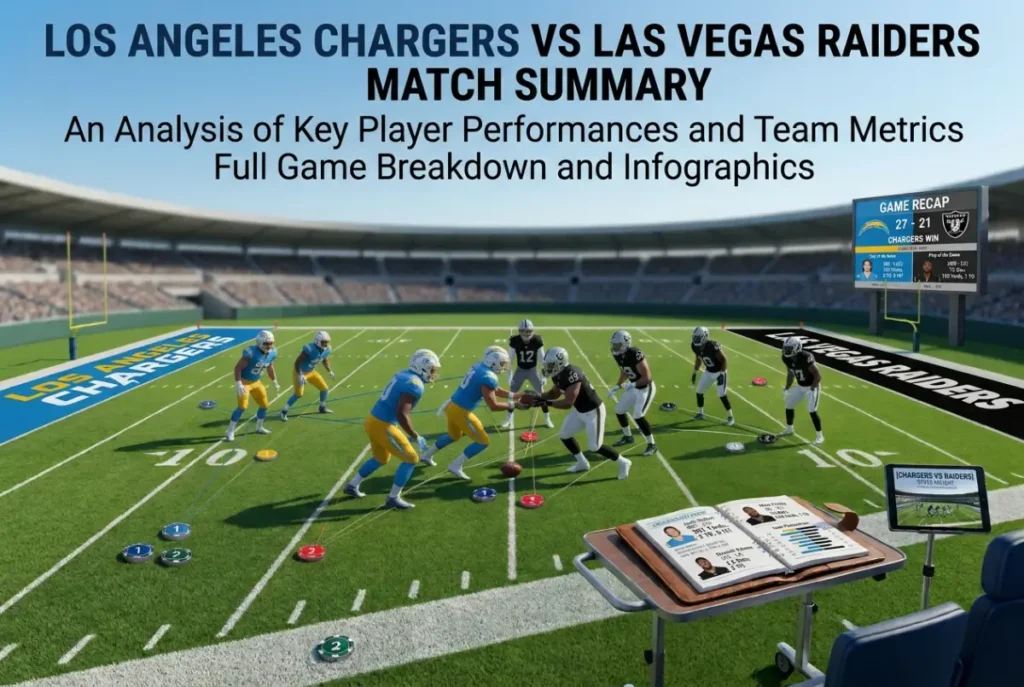
Los Angeles Chargers vs Las Vegas Raiders Match Summary
The Raiders defeated the Chargers 26–14 in their Week 2 meeting of the 2026 NFL regular season. Las Vegas scored 10 points in the second quarter, added seven in the third, and finished with nine in the fourth. Los Angeles scored seven points in each of the second and third quarters but failed to add to its total in the final period.
Final Score and Quarter-by-Quarter Results
| Team | Q1 | Q2 | Q3 | Q4 | Final |
|---|---|---|---|---|---|
| Las Vegas Raiders | 0 | 10 | 7 | 9 | 26 |
| Los Angeles Chargers | 0 | 7 | 7 | 0 | 14 |
Final result: Las Vegas Raiders 26, Los Angeles Chargers 14.
The opening quarter ended without either team scoring. The Raiders then created separation in the second quarter and maintained their advantage after halftime. Although the Chargers matched Las Vegas with seven points in the third quarter, the Raiders controlled the final period and secured a 12-point victory.
The official game box score records the individual passing, rushing, and receiving performances from both teams. These numbers provide a clearer picture of why the Raiders won and where the Chargers struggled.
Raiders Player Stats: Passing Performance
Kirk Cousins Leads Las Vegas
Kirk Cousins was one of the biggest reasons for the Raiders’ success. He completed 19 of 29 passes for 253 yards, three touchdowns, and one interception. His completion rate was 65.5%, and he averaged 8.7 yards per attempt.
| Passing Statistic | Kirk Cousins |
|---|---|
| Completions | 19 |
| Attempts | 29 |
| Completion percentage | 65.5% |
| Passing yards | 253 |
| Yards per attempt | 8.7 |
| Passing touchdowns | 3 |
| Interceptions | 1 |
| Passer rating | 113.1 |
Cousins’ three touchdown passes were especially important because they allowed the Raiders to turn successful drives into points. He also connected with his receivers on intermediate and deep throws, giving the offense opportunities to attack different areas of the field.
His 253 passing yards represented the majority of the Raiders’ offensive production through the air. Rather than depending exclusively on short passes, Las Vegas generated meaningful gains downfield. This helped the team move the chains and put pressure on the Chargers’ secondary.
Cousins did throw an interception, so his performance was not flawless. However, three touchdown passes and a passer rating above 110 made his overall outing highly productive.
For Las Vegas, the main takeaway was that its passing game could produce explosive plays without requiring an unusually high number of attempts. Cousins’ efficiency and ability to find scoring opportunities helped the Raiders build a lead they would not surrender.
Chargers Player Stats: Passing Performance
Justin Herbert’s Numbers
Justin Herbert completed 15 of 27 passes for 192 yards, one touchdown, and two interceptions. He finished with a 55.6% completion rate, 7.1 yards per attempt, and a passer rating of 59.5.
| Passing Statistic | Justin Herbert |
|---|---|
| Completions | 15 |
| Attempts | 27 |
| Completion percentage | 55.6% |
| Passing yards | 192 |
| Yards per attempt | 7.1 |
| Passing touchdowns | 1 |
| Interceptions | 2 |
| Passer rating | 59.5 |
Herbert’s 192 passing yards showed that the Chargers could still generate passing production. However, the two interceptions were costly because turnovers can erase the value of otherwise productive drives.
The difference between Herbert’s and Cousins’ performances was not simply total yardage. Cousins threw three touchdown passes against one interception, while Herbert finished with one touchdown against two interceptions. That difference in scoring efficiency gave Las Vegas a major advantage.
Herbert also completed a smaller percentage of his passes. When an offense struggles to maintain possession and convert opportunities into touchdowns, the defense has to spend more time on the field.
The Chargers needed better execution in key passing situations. Cleaner decisions, stronger protection, and improved timing with receivers would help Herbert produce more consistent results in future games.
These figures do not mean that the quarterback alone was responsible for the defeat. Football outcomes depend on blocking, receiving, play-calling, defensive performance, and field position. Still, the passing comparison clearly favored the Raiders in this matchup.
Rushing Stats: Omarion Hampton Leads the Chargers
Los Angeles Chargers Rushing Leaders
The Chargers found more success on the ground than through their passing game. Omarion Hampton led the team with 23 carries for 94 yards and one rushing touchdown. He averaged 4.1 yards per attempt and recorded a longest run of 17 yards.
| Player | Carries | Rushing Yards | Average | TD |
|---|---|---|---|---|
| Omarion Hampton | 23 | 94 | 4.1 | 1 |
| Keaton Mitchell | 5 | 24 | 4.8 | 0 |
| Quentin Johnston | 1 | 7 | 7.0 | 0 |
| Justin Herbert | 3 | 2 | 0.7 | 0 |
| Team total | 32 | 127 | 4.0 | 1 |
Hampton was the central figure in the Chargers’ rushing attack. His 94 yards demonstrated his ability to handle a substantial workload, while his touchdown provided a valuable scoring contribution.
Keaton Mitchell added 24 yards on five carries, averaging 4.8 yards per attempt. Although his workload was smaller, he gave the Chargers another option for gaining yards on the ground.
The team finished with 127 rushing yards on 32 attempts, averaging four yards per carry. That was a respectable total and a positive element of the Chargers’ offensive performance.
However, productive rushing numbers do not automatically translate into a victory. Teams must also protect the football, complete important third-down plays, and finish drives with touchdowns. Los Angeles did not score in the fourth quarter, which limited the impact of its rushing production.
Las Vegas Raiders Rushing Leaders
Ashton Jeanty led the Raiders in rushing attempts and yards. He carried the ball 21 times for 48 yards, averaging 2.3 yards per attempt. He did not score a rushing touchdown.
| Player | Carries | Rushing Yards | Average | TD |
|---|---|---|---|---|
| Ashton Jeanty | 21 | 48 | 2.3 | 0 |
| Mike Washington Jr. | 3 | 7 | 2.3 | 0 |
| Kirk Cousins | 4 | 1 | 0.3 | 0 |
| Connor Heyward | 1 | 1 | 1.0 | 0 |
| Team total | 29 | 57 | 2.0 | 0 |
The Raiders recorded just 57 rushing yards, well below the Chargers’ total. Jeanty received most of the work but found fewer opportunities to generate substantial gains.
Despite the limited rushing output, Las Vegas won because its passing game compensated for the ground game’s struggles. Cousins and the receiving group produced touchdowns that made a larger difference on the scoreboard.
This contrast is an important lesson from the game: a team does not need to dominate every statistical category to win. Strong passing efficiency and timely scoring can outweigh a disadvantage in rushing yards.
Receiving Stats: Tre Tucker Leads the Raiders
Las Vegas Receiving Leaders
Tre Tucker delivered the most productive receiving performance for Las Vegas. He caught five passes on seven targets for 119 yards and one touchdown. His average was 23.8 yards per reception, and his longest catch covered 42 yards.
| Player | Receptions | Targets | Receiving Yards | TD |
|---|---|---|---|---|
| Tre Tucker | 5 | 7 | 119 | 1 |
| Dareke Young | 1 | 1 | 27 | 0 |
| Jack Bech | 2 | 2 | 25 | 0 |
| Cody White | 2 | 2 | 24 | 2 |
| Michael Mayer | 3 | 4 | 23 | 0 |
| Ashton Jeanty | 4 | 7 | 15 | 0 |
| Ian Thomas | 1 | 1 | 11 | 0 |
| Jalen Nailor | 1 | 3 | 9 | 0 |
Tucker’s 119 yards made him the Raiders’ leading receiver. His average of 23.8 yards per catch highlights how effectively he turned receptions into substantial gains.
The Chargers had to account for his ability to stretch the field. When a receiver can produce explosive plays, defenders have less room to focus exclusively on short routes and the running game.
Cody White also made a major contribution. He caught two passes for 24 yards, and both receptions went for touchdowns. His two scoring catches demonstrated the value of making the most of opportunities in the red zone and other important passing situations.
Michael Mayer added three receptions for 23 yards, while Jack Bech contributed two catches for 25 yards. These supporting performances helped the Raiders distribute the ball instead of depending on one receiver for every successful play.
The receiving statistics show a useful balance between big-play production and finishing drives. Tucker generated substantial yardage, while White supplied the two-touchdown performance that helped turn passing opportunities into points.
Los Angeles Chargers Receiving Leaders
The Chargers had several contributors in the passing game, but no receiver reached Tucker’s 119-yard total.
| Player | Receptions | Targets | Receiving Yards | TD |
|---|---|---|---|---|
| Tre Harris | 1 | 3 | 53 | 0 |
| Ladd McConkey | 3 | 3 | 35 | 0 |
| Charlie Kolar | 3 | 3 | 21 | 0 |
| Omarion Hampton | 2 | 2 | 21 | 0 |
| Oronde Gadsden II | 2 | 2 | 18 | 1 |
| Keaton Mitchell | 1 | 1 | 15 | 0 |
| Brenen Thompson | 1 | 3 | 13 | 0 |
| David Njoku | 1 | 3 | 9 | 0 |
| Quentin Johnston | 1 | 5 | 7 | 0 |
| Derius Davis | 0 | 1 | 0 | 0 |
Tre Harris recorded the Chargers’ longest listed receiving gain, with one reception for 53 yards. Although he had only three targets, that catch accounted for a substantial portion of his receiving total.
Ladd McConkey caught all three of his targets for 35 yards. His perfect catch rate on those opportunities helped provide a reliable option for Herbert.
Oronde Gadsden II finished with two receptions for 18 yards and one touchdown. His score was an important contribution, although the Chargers needed more scoring production from the overall passing attack.
Quentin Johnston had one catch for seven yards on five targets. This line shows why target volume must be considered alongside completed receptions and yardage. Receiving opportunities alone do not guarantee meaningful offensive production.
Taken together, the Chargers’ passing numbers suggest a need for more consistent connections between the quarterback and the receiving group. Explosive gains were possible, but the offense needed to convert more opportunities into sustained drives and points.
Head-to-Head Statistical Comparison
The overall team statistics make the contrast between the two offenses easier to understand.
| Category | Raiders | Chargers |
|---|---|---|
| Final score | 26 | 14 |
| Passing yards | 253 | 192 |
| Rushing yards | 57 | 127 |
| Passing touchdowns | 3 | 1 |
| Rushing touchdowns | 0 | 1 |
| Passing interceptions | 1 | 2 |
| Total offensive yards | 310 | 319 |
The total offensive yardage figures above combine the reported passing and rushing totals. They should not be confused with official net offensive yardage, which may account for sacks and other adjustments.
The Chargers actually recorded more combined passing and rushing yards: 319 compared with 310 for Las Vegas. Yet the Raiders won by 12 points.
That contrast demonstrates why yardage alone is an incomplete measure of performance. Los Angeles gained more ground overall, but the Raiders scored more passing touchdowns and committed fewer interceptions.
Las Vegas also benefited from explosive receiving plays. Tucker’s 119 yards and White’s two touchdown catches helped make its passing attack more effective when it mattered most.
The Chargers, meanwhile, needed to turn their rushing advantage into additional points. Their 127 rushing yards were useful, but their offense could not produce a fourth-quarter score.
For fans comparing team statistics, the most useful approach is to examine yardage alongside turnovers, touchdowns, efficiency, and scoring by quarter. Together, these measurements explain the result more clearly than any single number.
Defensive Performance and Turnover Impact
Offensive box scores provide plenty of detail, but defense played an important role in the final result.
Herbert threw two interceptions, compared with Cousins’ one. Those turnovers were a significant difference between the quarterbacks’ performances and put additional pressure on the Chargers to respond.
Interceptions can change a game in several ways. They stop an offensive possession, create an opportunity for the opposing offense, and sometimes force a team to abandon its preferred game plan. Even when an interception does not immediately lead to points, it can change field position and momentum.
The Raiders also limited the Chargers to 14 points and kept them scoreless in the fourth quarter. That final-period defensive performance helped preserve the lead.
The Chargers, on the other hand, needed to find ways to make Cousins less comfortable. Limiting explosive passes, improving coverage on deep routes, and generating pressure without sacrificing coverage could be important adjustments in a future meeting.
It is important not to assign specific tackle, sack, or interception-return totals without a verified defensive box score. The confirmed quarterback interception figures and final scoring pattern are enough to identify turnovers and fourth-quarter defense as central themes of the game.
Key Moments That Shaped the Game
1. A Scoreless Opening Quarter
Neither team scored in the first quarter. The opening period gave both offenses time to assess the opposing defense, but it also meant that the second quarter became especially important for establishing control.
2. The Raiders Scored 10 Points in the Second Quarter
Las Vegas opened the scoring pattern with a 10-point second quarter. The Chargers answered with seven points, but the Raiders entered halftime with a three-point advantage.
That period gave Las Vegas the initial edge and demonstrated its ability to finish offensive possessions.
3. Both Teams Scored Seven in the Third Quarter
The third quarter was evenly matched on the scoreboard. Each team scored seven points, meaning the Raiders retained their three-point advantage heading into the final period.
The Chargers stayed close, but they needed a stronger finish to change the outcome.
4. Las Vegas Pulled Away in the Fourth Quarter
The Raiders added nine points in the fourth quarter, while Los Angeles failed to score. That difference turned a competitive game into a 12-point victory.
The final period was particularly important because it showed that Las Vegas could protect its lead and continue adding points under pressure.
What the Result Means for the Chargers
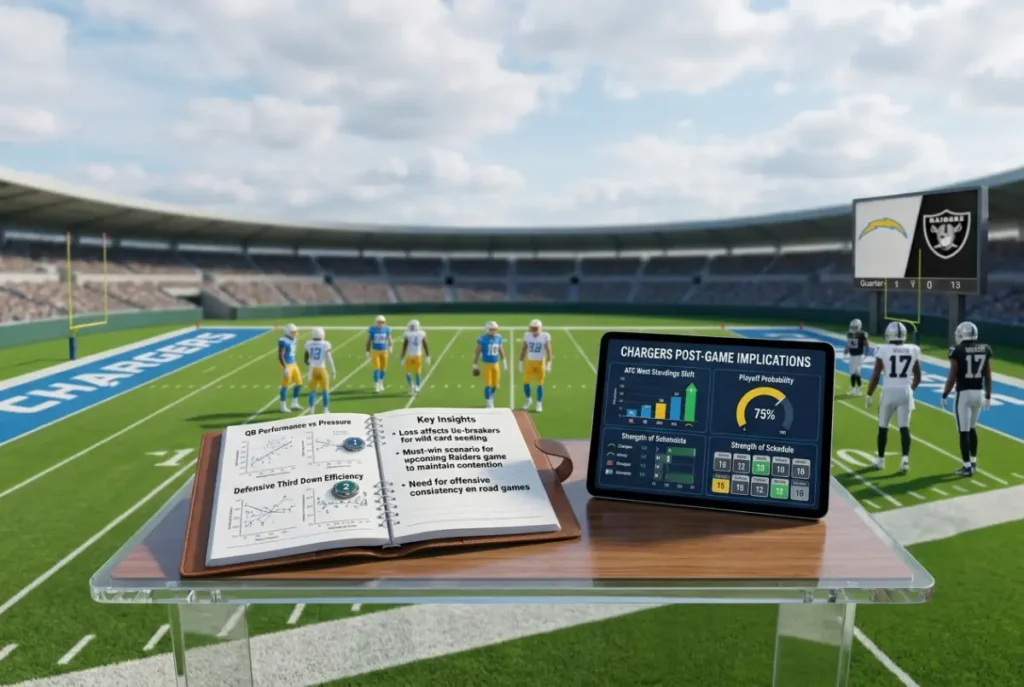
The Chargers can take some positives from their rushing production. Hampton’s 94 yards and touchdown were encouraging, and the team finished with 127 rushing yards overall.
However, Herbert’s two interceptions and the offense’s inability to score in the fourth quarter highlighted areas for improvement.
The coaching staff can review how the passing game handles pressure, how receivers create separation, and how the offense approaches critical downs. Better decision-making and fewer turnovers would help the team make greater use of its yardage advantage.
The Chargers also need to convert promising drives into touchdowns. Field position and time of possession can help an offense control a game, but points remain the ultimate measure of scoring success.
Defensively, limiting explosive plays should be a priority. Tucker’s 119 receiving yards showed the damage that a receiver can do when he finds space downfield. Improved coverage discipline and pressure on the quarterback could help reduce similar production in future matchups.
What the Result Means for the Raiders
The Raiders can build on a productive passing performance. Cousins threw for 253 yards and three touchdowns, while Tucker delivered a game-leading 119 receiving yards.
White’s two touchdown receptions also showed the importance of having multiple players capable of finishing drives. When the defense must account for several receiving threats, the offense becomes harder to predict.
Las Vegas should still examine its running game. Jeanty carried the ball 21 times but finished with only 48 yards. A more efficient ground attack could help the Raiders control the clock and reduce pressure on Cousins in future games.
The Raiders also need to avoid giving opponents extra opportunities through turnovers. Cousins’ interception was the one major negative in an otherwise effective passing performance.
Overall, the win provided evidence that Las Vegas could succeed through passing efficiency and timely scoring, even without a dominant rushing performance.
Frequently Asked Questions
What was the final score of the Chargers vs Raiders game?
The Las Vegas Raiders defeated the Los Angeles Chargers 26–14 on September 20, 2026, at SoFi Stadium in Inglewood, California.
Who was the best quarterback in the game?
Kirk Cousins had the stronger statistical performance. He completed 19 of 29 passes for 253 yards, three touchdowns, and one interception. Justin Herbert completed 15 of 27 passes for 192 yards, one touchdown, and two interceptions.
Who led the Raiders in receiving yards?
Tre Tucker led the Raiders with five receptions for 119 yards and one touchdown. His 23.8 yards per reception made him the most productive receiver in the game by yardage.
Who led the Chargers in rushing?
Omarion Hampton led the Chargers with 94 rushing yards on 23 carries. He averaged 4.1 yards per carry and scored one rushing touchdown.
How many touchdowns did Kirk Cousins throw?
Cousins threw three touchdown passes against the Chargers. Cody White caught two of those touchdown passes, while Tre Tucker also recorded a receiving touchdown.
How many interceptions did Justin Herbert throw?
Herbert threw two interceptions. Cousins threw one, giving the Chargers an additional turnover disadvantage in the quarterback comparison.
Which team had more total offensive yards?
Using the reported passing and rushing totals, the Chargers had 319 combined yards, while the Raiders had 310. Despite that small yardage disadvantage, Las Vegas won 26–14 because it converted its passing opportunities into more touchdowns.
Where can fans find the official box score?
Fans can review the game statistics through the NFL’s official game center and established sports-statistics websites. The official box score is the best place to verify individual player totals, team statistics, and scoring details.
Final Verdict
The September 20, 2026, matchup showed how passing efficiency and turnovers can determine the outcome of an AFC West game. Las Vegas defeated Los Angeles 26–14 despite recording fewer combined passing and rushing yards.
Cousins’ three touchdown passes, Tucker’s 119 receiving yards, and White’s two touchdown catches were major contributors to the Raiders’ win. Hampton’s 94 rushing yards and the Chargers’ overall ground production were notable positives for Los Angeles, but Herbert’s two interceptions and the fourth-quarter scoring gap proved costly.
For readers following los angeles chargers vs las vegas raiders match player stats, the biggest lesson is that box-score analysis requires more than comparing total yardage. Touchdowns, turnovers, explosive plays, and performance in key moments all help explain why one team wins and the other falls short.
The Raiders earned this divisional victory by making their passing opportunities count and finishing the game strongly. The Chargers showed some offensive potential on the ground but needed better passing efficiency and a more productive final quarter to change the result.

Hobby & Animal Names
Leo Hartman has owned dogs, birds, and one very difficult goat. He writes the hobby and animal names content here. Before any name makes the list, he tries it out loud first, usually on his dog, to see if it actually sounds right.